Updates

  1. Person pages list letters, writing, profiles and links as sortable tables with filters, and show each person's companies as links; Fund letters show each letter's description in its own column.
  2. Experts show a checked job title and a short description of each person; 30 more people have photographs.
  3. Every company, fund, university and publication the experts work for has a page listing the people there.
  4. Fund letters show each letter's thesis and filter by it; 225 person pages list the essays, columns and newsletter issues the person wrote.
  5. Person pages list every essay and newsletter issue a person wrote, and their own books as a table in List view.
  6. Recommends shows the five largest kinds of book and the rest under More; browse pictures load sooner.
  7. Podcasts and talks link the original episode, filter by Audio and video or Press, and list each publisher once.
  8. Pages are wider, Recommends has List and Grid, and a filter clicked again turns off.
  9. Book cards sit in a ruled grid with Open Library and Goodreads links and each book's one-line note.
  10. Funds is now Investors; each investor's styles are buttons that filter the table.
  11. Podcasts and talks on a person's page filter by year and publisher and show as a list or a grid of pictures.
  12. Quotes show only people's own words: 472 summaries written by list sites are gone.
  13. Country pages open from Browse again, and every link on the shelf lands on a page.
  14. Subject and person pages show their sections as tabs, and each book appears once on a person's page.
  15. Book cards show the quote, who said it and the source; grids show five cards to a row.
  16. On a phone, a menu holds the sections, search, Updates, Feedback and dark mode.
  17. Feedback takes a screenshot of the page with no browser prompt, opens a screenshot full size when you click it, and clears itself once sent.
  18. Book cards are centred, search names the topic each book sits in, and any text cut short shows whole on hover.
  19. Search groups its results by kind: people, companies, geographies, subjects, topics, books, funds, fund letters and papers.
  20. The Books table lists who recommended each book by name, and the browser tab names the section you are in.
  21. Feedback can take a screenshot of the page, or one you paste or choose, and opens in the corner beside Updates.
  22. Each rail button reopens its section where you left it, and Browse, Table and People show on every book and subject page.
  23. Filters grey out choices that hold nothing instead of hiding them, and Books › People filters by authors or recommenders.
  24. Feedback takes a subject line and up to three screenshots.
  25. Biographies are grouped by the person they are about: 41 new pages, from Abraham Lincoln to Lee Kuan Yew.
  26. Sport splits into 23 sports, and Religion into one topic per faith.
  27. Book lists show as cards: the cover, one recommendation quote and every recommender by name.
  28. Seventeen subjects that had two or three pages under different names now have one page each.
  29. Every page lists its Experts as authors and recommenders, with a link to them on the Experts tab.
  30. Economics, Financial history, Financial panics and Accounting are subjects of their own, with one page per financial crisis.
  31. Book, person and subject pages open inside the app, so the tabs stay in view.
  32. 996 more book covers, and photographs or logos for 227 more people and companies.
  33. Books › Browse shows every subject as cards, and the rail holds Fund letters, Papers, Experts, Books and Funds.
  34. Every topic over 150 books splits into narrower topics, each with a page of its own.

Send feedback

What is it?
Screenshots, up to 3 (optional)
or paste one with Ctrl+V

We use your email only to reply to you.

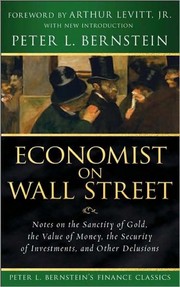
Economist on Wall Street

Economist on Wall Street

Peter L. Bernstein
1970
T4 304 pages · about 5h 4m to read Open Librarygoodreads

Summary

The reference has not verified this book in detail; the summary states only what the title, author and subject establish.

Bernstein published this in 1970, drawing on his experience running an investment counselling firm and writing about markets from an economist's perspective. It was reissued in 2008 with commentary by Peter Bernstein written shortly before his death.

The reference has not verified the book's detailed contents. What the period and the author establish is the context: Bernstein was writing at the end of the 1960s bull market, before the 1973 and 1974 collapse, before the inflation of that decade, before modern portfolio theory had been adopted in practice, and before index funds existed.

Bernstein's recurring positions across his career, which are visible in his later and better known books including Against the Gods and Capital Ideas, include the primacy of risk over return in investment thinking, scepticism about forecasting, attention to the relationship between economic conditions and asset prices, and an insistence that investors understand the assumptions embedded in whatever they hold.

A 1970 book on investing and economics is now a period document. The institutional environment, the tax treatment, the instruments available and the professional practice have all changed completely. The 2008 reissue was published because the questions Bernstein was raising about inflation, about the relationship between economic growth and equity returns, and about the limits of forecasting had become relevant again.

Readers wanting Bernstein's substantive contributions should read Against the Gods for the history of risk and Capital Ideas for the development of financial theory. This volume is of historical interest.

Key takeaways 6

  1. Bernstein wrote as an economist managing money, which was an unusual combination when investment practice and academic economics had little contact.
  2. The book was published at the end of the 1960s bull market, before the collapse and the inflation that followed.
  3. Its institutional context, including tax treatment, available instruments and professional practice, has changed completely.
  4. Bernstein's recurring position across his career was that risk rather than return should organise investment thinking.
  5. He was consistently sceptical of forecasting including by economists, which was his own profession.
  6. The 2008 reissue was prompted by the return of questions about inflation and about growth and equity returns.

Who should read it

Readers interested in Bernstein's early work as a period document, who should read Against the Gods and Capital Ideas for his substantive contributions.

About Peter L. Bernstein

Founder, Peter L. Bernstein Inc.; founding editor of The Journal of Portfolio Management; economist and financial historian (1919-2009)

Against the Gods and Capital Ideas are the standard accounts of risk and of modern finance theory, read across the whole field.

Peter L. Bernstein Inc.

Similar books 6

Chosen by shared topics, the entries that hold them, and the people who recommended both.

Ray Dalio · 2018

A template for how big debt crises unfold, with detailed case studies.

Lars Tvede · 1997

The history of business cycle theory and how credit cycles drive asset prices.

James P. O'Shaughnessy

Why large growth stocks would lag for twenty years, and what to hold instead.

Recommended by: Mohnish Pabrai

Ray Dalio · 2018

Free PDF at economicprinciples.org; first issued as A Template for Understanding Big Debt Crises.

Recommended by: Ray Dalio
Murray N. Rothbard · 1963

The Austrian account of 1929 and the policy response that followed

Where it sits in the reference 2

Investors
Economics

Topics

InvestingEconomics