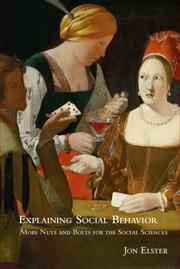
Explaining Social Behavior
Why social science should explain by mechanisms rather than by laws.
Elster on mechanisms rather than laws in the social sciences
Summary
Elster's book is a graduate-level statement of how social science explanation should work. His central position is that the social sciences have laws that are too weak to be useful and that the proper unit of explanation is the mechanism, meaning a frequently occurring and easily recognisable causal pattern that is triggered under generally unknown conditions and with indeterminate consequences.
He builds up from the individual: desires, beliefs, emotions, and the ways each is formed and distorted. He covers rational choice theory carefully and then sets out its limits, arguing that rationality is often indeterminate because the agent cannot know what information to gather, and that people frequently act on norms, emotions or self-deception instead. His treatment of emotions is unusually detailed for a methodology book, and he insists that emotions have cognitive antecedents and behavioural consequences that can be specified. The later sections cover interaction, collective action, aggregation, social norms and institutions.
Elster is severe about the state of his own field. He attacks what he calls soft obscurantism in interpretive social science and hard obscurantism in formal modelling and rational choice, arguing that a great deal of published work in economics and political science consists of models whose assumptions are chosen for tractability and whose conclusions are unfalsifiable. For investors and operators the useful content is the mechanism approach, which is a disciplined way of explaining behaviour without pretending to predict it, and the catalogue of specific mechanisms. The book is dense and demanding, and Elster's judgements about entire literatures are stated more forcefully than he defends them.
Key takeaways 7
- Social science can identify mechanisms but cannot produce laws, so explanation should aim at understanding what happened rather than predicting what will.
- A mechanism is a recognisable causal pattern whose triggering conditions and consequences are not known in advance, which is why several opposed mechanisms can each be valid.
- Rational choice explanation frequently fails because rationality is indeterminate, since the agent cannot rationally decide how much information to gather before deciding.
- Emotions have identifiable cognitive causes and behavioural effects and belong inside social science explanation rather than outside it.
- Social norms operate independently of outcomes and are sustained by the emotions of shame and contempt rather than by any calculation of benefit.
- Much formal modelling in economics and political science chooses assumptions for mathematical tractability and produces conclusions that cannot be tested.
- Explanation requires specifying the individual-level mechanism, since aggregate correlations without a mechanism do not explain anything.
Who should read it
Investors and analysts who want a rigorous account of what social science explanation can deliver, and a working vocabulary of behavioural mechanisms.
Who recommended it 2 · 1 direct
Similar books 6
Chosen by shared topics, the entries that hold them, and the people who recommended both.
Incentives and data applied to cheating teachers, sumo wrestlers and other puzzles.
“Also, see the story of cheating in the Chicago Public School system in Steven D. Levitt and Stephen J. Dubner, Freakonomics: A Rogue Economist Explores the Hidden Side of Everything (New York: Harper Perennial, 2009), 23-35” — Michael Mauboussin
Source: Blaming the Rat: Incentives, Motivation, and How They Interact, page 14
Recommended by: Michael Mauboussin, Mohnish Pabrai and 7 others

Data and incentives applied to climate, crime and altruism.
“I recommend this book to anyone who reads nonfiction. It is very well written and full of great insights.” — Bill Gates
Source: Gates Notes review of SuperFreakonomics
Recommended by: Bill Gates, Mohnish Pabrai
A sociologist studies a Chicago crack-dealing gang from the inside.
Recommended by: Mohnish Pabrai, Mark Zuckerberg
What each econometric technique is for, what it assumes and what goes wrong.
Recommended by: Nassim Nicholas Taleb
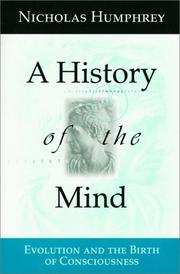
How consciousness and the senses evolved, and the history of the mind.
Recommended by: Mohnish Pabrai, Nassim Nicholas Taleb
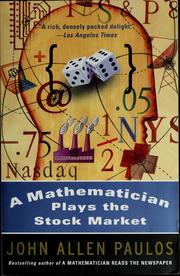
A mathematician's WorldCom losses, used to explain errors of probability in markets.
Recommended by: Mohnish Pabrai