Updates

  1. Person pages list letters, writing, profiles and links as sortable tables with filters, and show each person's companies as links; Fund letters show each letter's description in its own column.
  2. Experts show a checked job title and a short description of each person; 30 more people have photographs.
  3. Every company, fund, university and publication the experts work for has a page listing the people there.
  4. Fund letters show each letter's thesis and filter by it; 225 person pages list the essays, columns and newsletter issues the person wrote.
  5. Person pages list every essay and newsletter issue a person wrote, and their own books as a table in List view.
  6. Recommends shows the five largest kinds of book and the rest under More; browse pictures load sooner.
  7. Podcasts and talks link the original episode, filter by Audio and video or Press, and list each publisher once.
  8. Pages are wider, Recommends has List and Grid, and a filter clicked again turns off.
  9. Book cards sit in a ruled grid with Open Library and Goodreads links and each book's one-line note.
  10. Funds is now Investors; each investor's styles are buttons that filter the table.
  11. Podcasts and talks on a person's page filter by year and publisher and show as a list or a grid of pictures.
  12. Quotes show only people's own words: 472 summaries written by list sites are gone.
  13. Country pages open from Browse again, and every link on the shelf lands on a page.
  14. Subject and person pages show their sections as tabs, and each book appears once on a person's page.
  15. Book cards show the quote, who said it and the source; grids show five cards to a row.
  16. On a phone, a menu holds the sections, search, Updates, Feedback and dark mode.
  17. Feedback takes a screenshot of the page with no browser prompt, opens a screenshot full size when you click it, and clears itself once sent.
  18. Book cards are centred, search names the topic each book sits in, and any text cut short shows whole on hover.
  19. Search groups its results by kind: people, companies, geographies, subjects, topics, books, funds, fund letters and papers.
  20. The Books table lists who recommended each book by name, and the browser tab names the section you are in.
  21. Feedback can take a screenshot of the page, or one you paste or choose, and opens in the corner beside Updates.
  22. Each rail button reopens its section where you left it, and Browse, Table and People show on every book and subject page.
  23. Filters grey out choices that hold nothing instead of hiding them, and Books › People filters by authors or recommenders.
  24. Feedback takes a subject line and up to three screenshots.
  25. Biographies are grouped by the person they are about: 41 new pages, from Abraham Lincoln to Lee Kuan Yew.
  26. Sport splits into 23 sports, and Religion into one topic per faith.
  27. Book lists show as cards: the cover, one recommendation quote and every recommender by name.
  28. Seventeen subjects that had two or three pages under different names now have one page each.
  29. Every page lists its Experts as authors and recommenders, with a link to them on the Experts tab.
  30. Economics, Financial history, Financial panics and Accounting are subjects of their own, with one page per financial crisis.
  31. Book, person and subject pages open inside the app, so the tabs stay in view.
  32. 996 more book covers, and photographs or logos for 227 more people and companies.
  33. Books › Browse shows every subject as cards, and the rail holds Fund letters, Papers, Experts, Books and Funds.
  34. Every topic over 150 books splits into narrower topics, each with a page of its own.

Send feedback

What is it?
Screenshots, up to 3 (optional)
or paste one with Ctrl+V

We use your email only to reply to you.

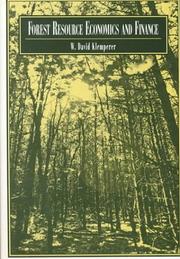
Forest Resource Economics and Finance

Forest Resource Economics and Finance

W. David Klemperer
1996
T4 551 pages · about 9h 11m to read Open Librarygoodreads

Standard textbook on rotation-age valuation and forest finance.

Summary

The reference has not verified this book in detail; the summary states only what the title, author and subject establish.

Klemperer wrote this as a textbook applying economic and financial analysis to forestry. The reference has not verified the detailed contents.

The subject has features that make it analytically distinct. A forest is a capital asset that grows, so the owner's decision is when to harvest, and the answer depends on the growth rate of the standing timber against the discount rate: while the timber grows in value faster than the alternative return on the capital tied up, holding is correct. This is the Faustmann problem, first formulated in 1849, and its solution determines optimal rotation length, which is shorter than the age of maximum biological growth because the land could be replanted and the cycle repeated.

Other territory includes the valuation of standing timber and of forest land; the treatment of a forest as a portfolio of stands of different ages; taxation, which affects rotation decisions substantially; risk including fire, disease, wind and price volatility; the economics of multiple use including recreation, watershed and habitat values that have no market price; carbon accounting; the difference between industrial forestry and non-industrial private ownership, which has different objectives; and public forest management where the objective is not commercial return.

Forest investment has become an institutional asset class since the book was written, with timberland investment management organisations and real estate investment trusts holding what forest products companies previously owned, which changed the ownership structure and the analytical requirements.

Readers should verify the book's specific coverage and supplement it with current material on carbon markets and institutional ownership.

Key takeaways 7

  1. A forest is a growing capital asset, so the harvest decision compares the timber's growth rate against the return available on the tied-up capital.
  2. Optimal rotation length is shorter than the age of maximum biological growth, because the land can be replanted and the cycle repeated.
  3. Taxation affects rotation decisions substantially, so tax treatment changes the physical management of the forest.
  4. A forest is best analysed as a portfolio of stands of different ages rather than as a single asset.
  5. Recreation, watershed and habitat values have no market price, which is why private and social optima diverge.
  6. Fire, disease, wind and price volatility are the risks that determine whether a rotation completes as planned.
  7. Institutional ownership through timberland investment vehicles has replaced forest products company ownership, which changed the analytical requirements.

Who should read it

Investors and managers in timberland and forestry who need the economic framework for harvest timing and valuation, supplemented with current material.

Similar books 6

Chosen by shared topics, the entries that hold them, and the people who recommended both.

Austin Frerick · 2024

How ownership of American agriculture came to sit with a few families and firms.

Arnaud Brohé, Nicholas Eyre, Nicholas Howarth · 2009

International business guide to allowances, offsets and registries.

Robert McNally · 2017

Argues price stability always required a swing producer or cartel.

Vaclav Smil · 2010

Each shift from wood to coal to oil took 50 to 70 years; new ones will be slow too.

Recommended by: Bill Gates

Brian Reisinger · 2024

Why family farms lose ground to consolidated ownership.

T2 Land
Simon Winchester · 2021

How land ownership shaped history: how people fight over, keep and share land.

Where it sits in the reference 2

Assets
Economics

Topics

EconomicsEnvironment and EnergyWater, food and land