Updates

  1. Person pages list letters, writing, profiles and links as sortable tables with filters, and show each person's companies as links; Fund letters show each letter's description in its own column.
  2. Experts show a checked job title and a short description of each person; 30 more people have photographs.
  3. Every company, fund, university and publication the experts work for has a page listing the people there.
  4. Fund letters show each letter's thesis and filter by it; 225 person pages list the essays, columns and newsletter issues the person wrote.
  5. Person pages list every essay and newsletter issue a person wrote, and their own books as a table in List view.
  6. Recommends shows the five largest kinds of book and the rest under More; browse pictures load sooner.
  7. Podcasts and talks link the original episode, filter by Audio and video or Press, and list each publisher once.
  8. Pages are wider, Recommends has List and Grid, and a filter clicked again turns off.
  9. Book cards sit in a ruled grid with Open Library and Goodreads links and each book's one-line note.
  10. Funds is now Investors; each investor's styles are buttons that filter the table.
  11. Podcasts and talks on a person's page filter by year and publisher and show as a list or a grid of pictures.
  12. Quotes show only people's own words: 472 summaries written by list sites are gone.
  13. Country pages open from Browse again, and every link on the shelf lands on a page.
  14. Subject and person pages show their sections as tabs, and each book appears once on a person's page.
  15. Book cards show the quote, who said it and the source; grids show five cards to a row.
  16. On a phone, a menu holds the sections, search, Updates, Feedback and dark mode.
  17. Feedback takes a screenshot of the page with no browser prompt, opens a screenshot full size when you click it, and clears itself once sent.
  18. Book cards are centred, search names the topic each book sits in, and any text cut short shows whole on hover.
  19. Search groups its results by kind: people, companies, geographies, subjects, topics, books, funds, fund letters and papers.
  20. The Books table lists who recommended each book by name, and the browser tab names the section you are in.
  21. Feedback can take a screenshot of the page, or one you paste or choose, and opens in the corner beside Updates.
  22. Each rail button reopens its section where you left it, and Browse, Table and People show on every book and subject page.
  23. Filters grey out choices that hold nothing instead of hiding them, and Books › People filters by authors or recommenders.
  24. Feedback takes a subject line and up to three screenshots.
  25. Biographies are grouped by the person they are about: 41 new pages, from Abraham Lincoln to Lee Kuan Yew.
  26. Sport splits into 23 sports, and Religion into one topic per faith.
  27. Book lists show as cards: the cover, one recommendation quote and every recommender by name.
  28. Seventeen subjects that had two or three pages under different names now have one page each.
  29. Every page lists its Experts as authors and recommenders, with a link to them on the Experts tab.
  30. Economics, Financial history, Financial panics and Accounting are subjects of their own, with one page per financial crisis.
  31. Book, person and subject pages open inside the app, so the tabs stay in view.
  32. 996 more book covers, and photographs or logos for 227 more people and companies.
  33. Books › Browse shows every subject as cards, and the rail holds Fund letters, Papers, Experts, Books and Funds.
  34. Every topic over 150 books splits into narrower topics, each with a page of its own.

Send feedback

What is it?
Screenshots, up to 3 (optional)
or paste one with Ctrl+V

We use your email only to reply to you.

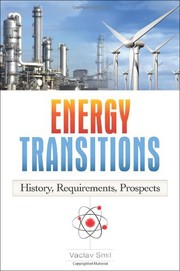
Energy Transitions

Energy Transitions

Vaclav Smil
2010
T1 178 pages · about 2h 58m to read Open Librarygoodreads

Summary

Smil examines historical energy transitions quantitatively, from wood to coal, coal to oil, and the additions of natural gas, nuclear and renewables, and derives from the record how long such transitions take and what determines their pace.

The empirical finding is the argument. Every major energy transition has taken between fifty and seventy years from the point a new source reached a small share of primary supply to the point it became dominant, and none has been fast. Coal took roughly sixty years to go from five percent to fifty percent of global primary energy. Oil took a similar period. Natural gas has still not completed the journey. The reason is scale: the existing energy system represents an enormous installed capital stock with long asset lives, the new source must be built out physically, and the supporting infrastructure of transport, storage and end-use equipment must be replaced alongside it.

He adds that transitions have historically been additions rather than substitutions. World coal consumption is higher now than when oil displaced it as the leading fuel, because total energy demand grew faster than the share shifted.

Smil is careful that this is a historical base rate rather than a physical law, and that policy and technology could in principle move faster. His position is that assertions of rapid transition should be measured against what has previously been achieved. Critics argue that solar and battery cost declines and the electrification of end uses represent a different dynamic from previous transitions.

Key takeaways 7

  1. Every major energy transition has taken between fifty and seventy years from a new source reaching a small share of supply to becoming dominant.
  2. Transitions have historically been additions rather than substitutions, and world coal consumption is higher now than when oil overtook it.
  3. The pace of transition is set by the installed capital stock's asset life and by the need to replace transport, storage and end-use equipment alongside generation.
  4. Energy density and the physical characteristics of a fuel determine what infrastructure it requires, which is why substitution is not simply a matter of cost.
  5. Scale is the binding constraint, since the existing system supplies an enormous absolute quantity that a new source must match in physical terms.
  6. Historical transition rates are a base rate against which claims about future speed should be measured rather than a physical limit.
  7. Rapid transitions have occurred at national scale in specific cases, which shows policy can accelerate the process where the conditions permit.

Who should read it

Energy investors and policy readers who need historical base rates for how fast energy systems actually change.

About Vaclav Smil

Distinguished professor emeritus at the University of Manitoba; writes quantitative histories of energy, food, materials and technical change.

Each book counts the physical inputs an economy consumes - joules, tonnes of steel, ammonia, cement - and establishes the historical rates at which past energy transitions actually moved. Those numbers let an investor size decarbonisation timelines and test claims about how fast an energy system can be rebuilt.

University of Manitoba

Who recommended it 1 · 1 direct

Similar books 6

Chosen by shared topics, the entries that hold them, and the people who recommended both.

Vaclav Smil · 2008

A short technical primer on oil: geology, extraction, refining, uses and reserves.

Recommended by: Mohnish Pabrai
Vaclav Smil · 2013

How much steel, cement and plastic the world uses, and whether growth needs less.

Recommended by: Bill Gates, Mohnish Pabrai

Peter W. Huber, Mark P. Mills · 2005

Why energy demand never falls, why 'waste' helps, and why quality power is scarce.

Recommended by: Mohnish Pabrai

Vaclav Smil · 2006

A short primer on energy: its forms, units and role in nature and economies.

Recommended by: Bill Gates, Mark Zuckerberg
Vaclav Smil · 2017

History told through energy, from muscle and fire to coal, oil and electricity.

Where it sits in the reference 2

Academics
Economics

Topics

Environment and EnergyEconomicsElectricity, nuclear and renewables