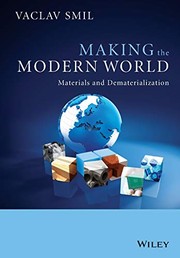
Making the Modern World: Materials and Dematerialization
Summary
Smil quantifies the material basis of modern civilisation: how much steel, cement, ammonia, plastics, aluminium, wood, glass and paper humanity produces and consumes, how those quantities have changed, and whether economic growth is decoupling from material throughput as is often claimed.
The data work is the substance. Smil assembles long series of production and consumption per capita across countries, traces the material intensity of specific products, and separates relative dematerialisation, where material use per unit of output falls, from absolute dematerialisation, where total use falls. His finding is that relative dematerialisation is real and substantial, that absolute dematerialisation has not occurred at the global level for any major material, and that efficiency gains have been consumed by growth in quantity and size, which is the rebound effect. He gives the specific case of cars becoming more materially efficient per unit while growing larger and more numerous.
He is direct about what this means for energy transition and for claims about a weightless economy. Producing steel, cement and ammonia at current scale requires high-temperature process heat and chemical reduction that renewable electricity does not straightforwardly supply, and the global stock of infrastructure implies decades of continued demand. The book is dense with tables and is written as reference rather than argument, which makes it hard reading and hard to dispute. Smil's scepticism about rapid transition is contested by researchers who think he underweights technological substitution, and the data ends around 2010.
Key takeaways 7
- Global material consumption has grown continuously and no major material has shown absolute reduction in total use, whatever the efficiency improvements per unit.
- Relative dematerialisation is real, meaning material required per unit of output has fallen substantially, but growth in output has more than offset it.
- Steel, cement and ammonia are the three materials on which modern civilisation depends most and each requires processes that are difficult to decarbonise.
- The rebound effect consistently converts efficiency gains into greater consumption rather than into reduced total throughput.
- Claims that advanced economies have dematerialised depend on excluding the materials embodied in imported goods.
- Ammonia synthesis feeds roughly half the world's population through nitrogen fertiliser, which makes it the least substitutable industrial process in existence.
- Infrastructure built from concrete and steel commits decades of future material demand for maintenance and replacement regardless of any policy decision.
Who should read it
Investors and operators in industrials, energy or climate who need quantified material flows rather than assertions about decoupling.
About Vaclav Smil
Distinguished professor emeritus at the University of Manitoba; writes quantitative histories of energy, food, materials and technical change.
Each book counts the physical inputs an economy consumes - joules, tonnes of steel, ammonia, cement - and establishes the historical rates at which past energy transitions actually moved. Those numbers let an investor size decarbonisation timelines and test claims about how fast an energy system can be rebuilt.
Who recommended it 2 · 2 direct
Similar books 6
Chosen by shared topics, the entries that hold them, and the people who recommended both.
Each shift from wood to coal to oil took 50 to 70 years; new ones will be slow too.
Recommended by: Bill Gates

A short technical primer on oil: geology, extraction, refining, uses and reserves.
Recommended by: Mohnish Pabrai

How the diesel engine and the gas turbine made modern global trade possible.
Recommended by: Bill Gates, Mohnish Pabrai

How organisms, populations, machines, economies and civilisations grow, and stop.
Recommended by: Bill Gates

How American manufacturing rose to lead the world, and why its share then fell.
Recommended by: Mohnish Pabrai

Seventy-one short pieces that correct common impressions with plain arithmetic.
Recommended by: Bill Gates, Mark Zuckerberg and 1 other
Where it sits in the reference 2
Topics