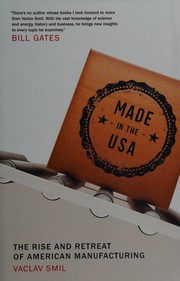
Made in the USA: The Rise and Retreat of American Manufacturing
Summary
Smil examines the history of American manufacturing quantitatively, from the nineteenth century through its rise to global dominance and its subsequent decline in employment and in share of output.
The historical material documents what American manufacturing achieved: the development of interchangeable parts and the American system of manufactures, the assembly line, the mass production of consumer durables, the wartime mobilisation, and the postwar period in which American industry produced a very large share of world output.
His analysis of the decline separates several things that are usually conflated. Manufacturing employment fell far more than manufacturing output, because productivity growth reduced the labour required per unit. But he argues, against the standard account, that output growth has also been weaker than the aggregate statistics suggest, because the computer and electronics sector's hedonic price adjustments inflate measured real output for the whole sector while most other industries stagnated or declined.
His argument for why manufacturing matters covers innovation, since research and development concentrates where production occurs; the trade balance, since services have not offset the goods deficit; employment quality, since manufacturing supported wages that service employment has not replaced; and national capability, since a country that cannot make things cannot make them in an emergency.
The book is dense with data. Its measurement argument about hedonic adjustment is technical and is the part most likely to change a reader's understanding of the statistics. Smil is pessimistic about reversal and offers no programme.
Key takeaways 7
- Manufacturing employment fell far more than output because productivity growth reduced the labour required per unit, and the two declines have different causes.
- Aggregate manufacturing output growth is overstated because hedonic price adjustments in computers and electronics inflate the measured real output of the whole sector.
- Excluding computers and electronics, most American manufacturing industries stagnated or declined in real output over recent decades.
- Research and development concentrates where production occurs, so losing manufacturing capability degrades innovation capacity with a lag.
- Services have not offset the goods trade deficit, which means the manufacturing decline has a persistent external balance consequence.
- Manufacturing supported wage levels that service sector employment has not replaced for workers with the same qualifications.
- National capability to produce goods in an emergency depends on maintaining production capacity that commercial calculation does not justify.
Who should read it
Investors and policy readers who want quantified analysis of American manufacturing's decline and the measurement issues that obscure it.
About Vaclav Smil
Distinguished professor emeritus at the University of Manitoba; writes quantitative histories of energy, food, materials and technical change.
Each book counts the physical inputs an economy consumes - joules, tonnes of steel, ammonia, cement - and establishes the historical rates at which past energy transitions actually moved. Those numbers let an investor size decarbonisation timelines and test claims about how fast an energy system can be rebuilt.
Who recommended it 1 · 1 direct
Similar books 6
Chosen by shared topics, the entries that hold them, and the people who recommended both.
How Britain, Germany, Japan and the US each built their own form of capitalism.
Recommended by: Mohnish Pabrai

How inventions of 1867 to 1914, from electricity to cars, made the modern world.
Recommended by: Mohnish Pabrai, Bill Gates

How organisms, populations, machines, economies and civilisations grow, and stop.
Recommended by: Bill Gates
How much steel, cement and plastic the world uses, and whether growth needs less.
Recommended by: Bill Gates, Mohnish Pabrai

Seventy-one short pieces that correct common impressions with plain arithmetic.
Recommended by: Bill Gates, Mark Zuckerberg and 1 other

How the diesel engine and the gas turbine made modern global trade possible.
Recommended by: Bill Gates, Mohnish Pabrai
Where it sits in the reference 2
Topics