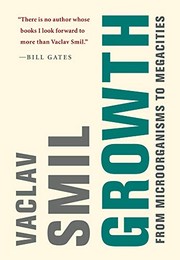
Growth
Summary
Smil examines growth as a general phenomenon across domains: the growth of organisms, of populations, of energy conversions, of artefacts including engines, ships, buildings and computers, of economies, and of civilisations. The book is long, dense with data and organised as a reference.
His unifying finding is that growth in nature and in engineered systems follows S-shaped trajectories: a slow start, a rapid expansion phase, and then a deceleration to a limit set by physical, thermodynamic or material constraints. He documents this across hundreds of cases with the fitted curves, and argues that the exponential phase visible in the middle is always temporary and is always mistaken for the permanent condition by those living through it.
He applies this to specific technologies, showing that engine efficiency, aircraft speed, crop yields and building heights all followed the pattern and plateaued, and to energy conversion, where the maximum efficiencies of most processes are now close to their thermodynamic limits. His treatment of computing is careful: he notes it is the outstanding exception in duration but argues the physical limits are approaching.
His conclusion is that continued material and energy growth on a finite planet is not available, and that the question is whether the deceleration is managed or forced.
The book is a reference work rather than an argument to be read through. Its data assembly is its value. Critics note that identifying S-curves after the fact is easier than predicting where a current curve sits, and that Smil's scepticism about future technological limits has been wrong before, particularly on computing.
Key takeaways 7
- Growth across organisms, technologies and economies follows S-shaped trajectories with a temporary exponential phase that is always mistaken for the permanent condition.
- Physical, thermodynamic and material constraints set the limits, which means the plateau is determined by the domain rather than by choice.
- Most energy conversion efficiencies are now close to their thermodynamic limits, so further gains must come from doing less rather than doing it better.
- Engine efficiency, aircraft speed, crop yields and building heights all followed the same trajectory and plateaued decades ago.
- Computing is the outstanding exception in the duration of its exponential phase, and its physical limits are nonetheless approaching.
- Continued material and energy growth on a finite planet is not available, and the question is whether deceleration is managed or forced.
- Identifying an S-curve after the fact is straightforward while locating a current trajectory on its own curve is not, which is the method's practical limit.
Who should read it
Investors and operators who want quantified evidence on how growth trajectories end across technologies, populations and economies.
About Vaclav Smil
Distinguished professor emeritus at the University of Manitoba; writes quantitative histories of energy, food, materials and technical change.
Each book counts the physical inputs an economy consumes - joules, tonnes of steel, ammonia, cement - and establishes the historical rates at which past energy transitions actually moved. Those numbers let an investor size decarbonisation timelines and test claims about how fast an energy system can be rebuilt.
Who recommended it 1 · 1 direct
Similar books 6
Chosen by shared topics, the entries that hold them, and the people who recommended both.
Seventy-one short pieces that correct common impressions with plain arithmetic.
Recommended by: Bill Gates, Mark Zuckerberg and 1 other
How American manufacturing rose to lead the world, and why its share then fell.
Recommended by: Mohnish Pabrai
How much steel, cement and plastic the world uses, and whether growth needs less.
Recommended by: Bill Gates, Mohnish Pabrai

A short primer on energy: its forms, units and role in nature and economies.
Recommended by: Bill Gates, Mark Zuckerberg

How Haber and Bosch's ammonia synthesis transformed world food production.
Recommended by: Mohnish Pabrai, Bill Gates
The physical basics of modern life: energy, food, materials and globalisation.
Recommended by: Bill Gates
Where it sits in the reference 2
Topics