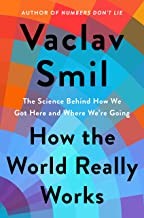
How the World Really Works
The materials and energy arithmetic that any transition thesis has to survive.
Summary
Smil condenses decades of his own quantitative work into a book for general readers, covering energy, food production, materials, globalisation, risk, the environment and the future.
The organising claim is that modern civilisation rests on physical realities that most public discussion ignores. His four pillars of modern civilisation are ammonia, steel, concrete and plastics, and he gives the production quantities, the energy required and the reasons none has a straightforward substitute at scale. Ammonia synthesis through the Haber-Bosch process supplies the nitrogen fertiliser that feeds roughly half the world's population, and it consumes natural gas both as feedstock and as energy.
His food chapter quantifies the fossil fuel embedded in what people eat, giving figures for the diesel equivalent required to produce a loaf of bread, a chicken, a tomato grown in a heated greenhouse and farmed seafood. The energy chapter covers power density, which is the quantity of energy produced per unit of land, and argues this is the constraint that determines how much land a renewable system requires.
His risk chapter compares actual mortality rates across activities against public perception, and his final chapter rejects both catastrophism and techno-optimism, arguing the future is genuinely uncertain and that anyone claiming otherwise is not reasoning from the numbers.
The book is the most accessible entry to Smil's work. Its scepticism about transition speed is a position within a live dispute, and critics argue he underweights the pace of cost decline in solar, batteries and electrification.
Key takeaways 7
- Modern civilisation rests on four materials, being ammonia, steel, concrete and plastics, and none has a straightforward substitute at current scale.
- Ammonia synthesis feeds roughly half the world's population through nitrogen fertiliser and consumes natural gas as both feedstock and energy.
- Producing food requires substantial fossil energy inputs, which can be quantified per item and which most consumers would not estimate correctly.
- Power density, meaning energy produced per unit of land, determines how much land a renewable energy system requires and is rarely included in transition plans.
- Public perception of risk diverges enormously from measured mortality rates across activities, in directions that are consistent and predictable.
- Decarbonising steel, cement and ammonia requires replacing high-temperature process heat and chemical reduction, which electrification does not straightforwardly supply.
- Both catastrophist and techno-optimist forecasts fail to reason from quantities, and the honest position on the future is uncertainty.
Who should read it
Investors and operators who want the quantitative physical basis of the food, energy and materials systems their businesses depend on.
About Vaclav Smil
Distinguished professor emeritus at the University of Manitoba; writes quantitative histories of energy, food, materials and technical change.
Each book counts the physical inputs an economy consumes - joules, tonnes of steel, ammonia, cement - and establishes the historical rates at which past energy transitions actually moved. Those numbers let an investor size decarbonisation timelines and test claims about how fast an energy system can be rebuilt.
Who recommended it 1 · 1 direct
Similar books 6
Chosen by shared topics, the entries that hold them, and the people who recommended both.

A short primer on energy: its forms, units and role in nature and economies.
Recommended by: Bill Gates, Mark Zuckerberg
History told through energy, from muscle and fire to coal, oil and electricity.
Recommended by: Balaji S. Srinivasan, Bill Gates and 1 other

Six materials the world runs on, sand, salt, iron, copper, oil and lithium, traced.
Data-driven look at emissions and what actually reduces them
Recommended by: Bill Gates

How Haber and Bosch's ammonia synthesis transformed world food production.
Recommended by: Mohnish Pabrai, Bill Gates
Each shift from wood to coal to oil took 50 to 70 years; new ones will be slow too.
Recommended by: Bill Gates
Where it sits in the reference 2
Topics