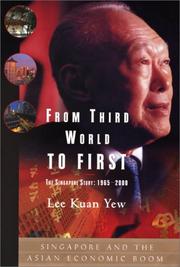
From Third World to First
How Singapore's leaders chose policies, from courting multinationals onward.
The founder's own account of how the development strategy was chosen.
Summary
Lee governed Singapore from 1959 to 1990 and wrote this second volume of his memoirs covering the period after independence, describing how the policies were chosen and what he considered to have worked.
The economic material covers the decision to attract multinational manufacturers when the prevailing development orthodoxy opposed dependence on foreign capital, the creation of the Economic Development Board as a single point of contact for investors, the Central Provident Fund which forced high savings rates and funded housing, the housing programme which gave the majority of the population an ownership stake, the establishment of Singapore as a financial centre, and the deliberate use of English as the working language.
The governance material covers the anti-corruption approach, which combined high public salaries with severe enforcement applied to senior figures; the recruitment of the ablest graduates into government through scholarships with service obligations; and the argument that a small country's only resource is the quality of its people, which drove the education and immigration policies.
The political material is where the book is most contested. Lee defends the restrictions on press, on assembly and on opposition parties, and the use of defamation suits against political opponents, on the argument that Singapore's circumstances required them and that the results justify them. This is a self-account by a leader defending his own record, and the treatment of the political restrictions is advocacy. Critics dispute both the necessity of the restrictions and the claim that they explain the economic outcome. The specific policy mechanics, particularly the provident fund and the investment attraction machinery, are documented usefully.
Key takeaways 8
- Singapore attracted multinational manufacturers deliberately when the prevailing development orthodoxy opposed dependence on foreign capital.
- A single government agency acting as the point of contact for investors removed the bureaucratic friction that deterred them elsewhere.
- A forced savings scheme funded both retirement provision and a housing programme that gave the majority an ownership stake.
- High public salaries combined with severe enforcement applied to senior figures was the anti-corruption approach, and both components were required.
- Recruiting the ablest graduates into government through scholarships with service obligations built state capability deliberately.
- English was adopted as the working language for economic reasons rather than cultural ones, and the decision was made against substantial resistance.
- A country without natural resources has only the quality of its people, which drove the education and selective immigration policies.
- Lee defends restrictions on press, assembly and opposition as necessary, which is contested by critics who dispute both the necessity and the causal claim.
Who should read it
Investors and policy readers interested in state-led development mechanics, read as a self-account defending a contested record.
Who recommended it 5 · 5 direct
Similar books 6
Chosen by shared topics, the entries that hold them, and the people who recommended both.
Lee Kuan Yew's views on China, the United States and world strategy, by topic.
Recommended by: Mohnish Pabrai, Shane Parrish
A founding leader's account of his life and Singapore's politics and history.
Recommended by: Patrick Collison, Tim Ferriss
Why some Asian nations grew rich: land reform, export-led industry, directed credit.
“it's a good read for anyone who wants to understand what actually determines whether a developing economy will succeed.” — Bill Gates
Source: Gates Notes review of How Asia Works
Recommended by: Bill Gates, Mohnish Pabrai, Patrick Collison
Essays reassessing Singapore's development model, its limits and what comes next.
An IMF economist on which Singapore policies caused its success and which transfer.
John Cowperthwaite, Hong Kong's Financial Secretary in the 1960s, and his policies.
Where it sits in the reference 3
Topics 5
As an Amazon Associate I earn from qualifying purchases.