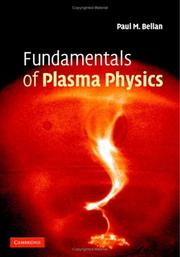
Fundamentals of Plasma Physics
A graduate textbook on the principles of plasma physics.
Summary
Paul M. Bellan wrote this textbook for beginning graduate students and advanced undergraduates, emphasising principles that apply across many contexts. It is aimed at students and researchers in physics, astronomy, space physics, electrical engineering and aeronautics, and is relevant to controlled fusion, astrophysical and solar plasmas, magnetospheric plasmas and plasma thrusters. The publisher describes it as more thorough than earlier texts and as using new mathematical techniques to give deeper insight into how plasmas behave.
After deriving the basic plasma equations from first principles, Bellan examines the motion of single particles, with particular attention to adiabatic invariance. He then covers the types of plasma waves and the question of Landau damping, and treats magnetohydrodynamic equilibrium and stability with emphasis on the topological ideas of magnetic helicity and self-organisation. Advanced chapters cover magnetic reconnection, nonlinear waves and the Fokker-Planck treatment of collisions, and the book ends with unconventional plasmas such as non-neutral and dusty plasmas.
Key takeaways 4
- The plasma equations are derived from first principles before being applied.
- Adiabatic invariance governs much of single-particle motion in plasmas.
- Magnetic helicity and self-organisation are central to magnetohydrodynamic stability.
- The same principles apply to fusion devices, the Sun and spacecraft thrusters.
Who should read it
Graduate and advanced undergraduate students in physics, astronomy and engineering studying plasmas.
Who recommended it 1
Similar books 6
Chosen by shared topics, the entries that hold them, and the people who recommended both.
The mathematical principles of time, force and motion behind modern physics.
Recommended by: Paul Graham, Sam Altman
An elementary introduction to gauge theory in physics.
Recommended by: Eric Weinstein
The graduate textbook on quantum field theory, QED and Feynman diagrams.
Recommended by: Susan J. Fowler
A graduate reference on the analysis and geometry used in mathematical physics.
Recommended by: Eric Weinstein
A textbook on classical mechanics for students past introductory physics.
Recommended by: Mohnish Pabrai