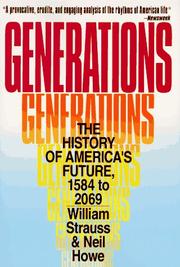
Generations
American history as a run of generations, and the theory that they repeat.
Summary
Strauss and Howe tell the history of America as a succession of generational biographies going back to 1584, and set out what became the Strauss–Howe generational theory: that American history moves in cycles of crisis and resurgence. They identify a recurring pattern in Anglo-American history of four generational types, each with a distinct collective persona, and a matching cycle of four types of era, each with its own mood.
The book began when the two authors, who had each written on generational topics, met in Washington and asked why Boomers and the G.I. generation saw the world so differently, and whether earlier generations had behaved in similar ways; their research found historical analogues. Published in 1991 with the subtitle The History of America's Future, 1584–2069, it laid the groundwork that they expanded in The Fourth Turning (1997), and it helped popularise the idea that people who come of age in the same period share beliefs, attitudes and behaviour.
Key takeaways 4
- Generations that come of age in the same period share a collective outlook.
- Strauss and Howe find four generational types that recur in sequence through American history.
- Eras alternate between crisis and resurgence in a repeating cycle of four moods.
- The authors use the pattern to project American history forward to 2069.
Who should read it
Readers interested in generational theory and in long cycles of history, read as a speculative framework.
Who recommended it 2 · 1 direct
Similar books 6
Chosen by shared topics, the entries that hold them, and the people who recommended both.
American history as a repeating cycle of four generational turnings, each 20 years.
Recommended by: Balaji S. Srinivasan, Mohnish Pabrai and 3 others
The stories of the Americans who fought the Second World War, from a TV journalist.
Recommended by: Mohnish Pabrai
How eugenics arguments kept Jews, Italians and others out of the United States.
Recommended by: Marc Andreessen
The decades-long migration of black Americans out of the South.
Recommended by: Barack Obama, Michelle Obama
150 essays on the events that shaped the city of Chicago.
Recommended by: Mohnish Pabrai
How English regional cultures shaped early American society and its regions.
Recommended by: Balaji S. Srinivasan