Updates

  1. Person pages list letters, writing, profiles and links as sortable tables with filters, and show each person's companies as links; Fund letters show each letter's description in its own column.
  2. Experts show a checked job title and a short description of each person; 30 more people have photographs.
  3. Every company, fund, university and publication the experts work for has a page listing the people there.
  4. Fund letters show each letter's thesis and filter by it; 225 person pages list the essays, columns and newsletter issues the person wrote.
  5. Person pages list every essay and newsletter issue a person wrote, and their own books as a table in List view.
  6. Recommends shows the five largest kinds of book and the rest under More; browse pictures load sooner.
  7. Podcasts and talks link the original episode, filter by Audio and video or Press, and list each publisher once.
  8. Pages are wider, Recommends has List and Grid, and a filter clicked again turns off.
  9. Book cards sit in a ruled grid with Open Library and Goodreads links and each book's one-line note.
  10. Funds is now Investors; each investor's styles are buttons that filter the table.
  11. Podcasts and talks on a person's page filter by year and publisher and show as a list or a grid of pictures.
  12. Quotes show only people's own words: 472 summaries written by list sites are gone.
  13. Country pages open from Browse again, and every link on the shelf lands on a page.
  14. Subject and person pages show their sections as tabs, and each book appears once on a person's page.
  15. Book cards show the quote, who said it and the source; grids show five cards to a row.
  16. On a phone, a menu holds the sections, search, Updates, Feedback and dark mode.
  17. Feedback takes a screenshot of the page with no browser prompt, opens a screenshot full size when you click it, and clears itself once sent.
  18. Book cards are centred, search names the topic each book sits in, and any text cut short shows whole on hover.
  19. Search groups its results by kind: people, companies, geographies, subjects, topics, books, funds, fund letters and papers.
  20. The Books table lists who recommended each book by name, and the browser tab names the section you are in.
  21. Feedback can take a screenshot of the page, or one you paste or choose, and opens in the corner beside Updates.
  22. Each rail button reopens its section where you left it, and Browse, Table and People show on every book and subject page.
  23. Filters grey out choices that hold nothing instead of hiding them, and Books › People filters by authors or recommenders.
  24. Feedback takes a subject line and up to three screenshots.
  25. Biographies are grouped by the person they are about: 41 new pages, from Abraham Lincoln to Lee Kuan Yew.
  26. Sport splits into 23 sports, and Religion into one topic per faith.
  27. Book lists show as cards: the cover, one recommendation quote and every recommender by name.
  28. Seventeen subjects that had two or three pages under different names now have one page each.
  29. Every page lists its Experts as authors and recommenders, with a link to them on the Experts tab.
  30. Economics, Financial history, Financial panics and Accounting are subjects of their own, with one page per financial crisis.
  31. Book, person and subject pages open inside the app, so the tabs stay in view.
  32. 996 more book covers, and photographs or logos for 227 more people and companies.
  33. Books › Browse shows every subject as cards, and the rail holds Fund letters, Papers, Experts, Books and Funds.
  34. Every topic over 150 books splits into narrower topics, each with a page of its own.

Send feedback

What is it?
Screenshots, up to 3 (optional)
or paste one with Ctrl+V

We use your email only to reply to you.

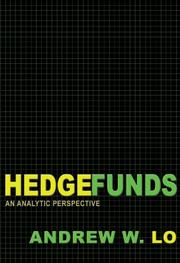
Hedge Funds: An Analytic Perspective

Hedge Funds: An Analytic Perspective

Andrew W. Lo
2008
T4 361 pages · about 6h 1m to read Open Librarygoodreads

Princeton University Press; revised edition 2010.

Summary

Lo, an MIT finance professor who has also run a quantitative fund, collected his research on hedge funds into a coherent treatment of how the industry's returns should be measured and what risks they carry.

His most consequential finding concerns illiquidity and smoothed returns. Reported hedge fund returns frequently exhibit positive serial correlation, meaning this month's return predicts next month's, which should not occur in an efficiently traded portfolio. Lo shows that the cause is valuation: funds holding illiquid positions mark them infrequently or using stale or modelled prices, which smooths the reported series. Smoothing reduces measured volatility without reducing actual risk, which inflates Sharpe ratios and understates correlation with markets. He develops an econometric method for estimating the degree of smoothing from the serial correlation and for recovering the underlying volatility, and shows that adjusted Sharpe ratios for illiquid strategies are substantially lower than reported.

His second contribution concerns the shape of hedge fund returns. Many strategies have payoffs resembling written options: small steady gains most of the time with occasional large losses. Lo shows that conventional risk measures based on volatility cannot capture this, and that a strategy can produce an excellent record for years while carrying a large embedded tail exposure.

He also covers database biases, since funds self-report and failed funds disappear, which overstates measured industry returns; capacity constraints, where a strategy's returns decline as assets grow; the systemic risk from correlated positions and shared prime broker financing, which he raised before 2008; and the measurement of liquidity risk.

The book is technical and assumes econometrics. The serial correlation finding has become standard in institutional due diligence and is the most practically useful result in the hedge fund literature.

Key takeaways 7

  1. Positive serial correlation in reported hedge fund returns indicates smoothed valuation of illiquid positions rather than predictable performance.
  2. Smoothed returns reduce measured volatility without reducing actual risk, which inflates reported Sharpe ratios substantially.
  3. Correlation with equity markets is understated by smoothing, so illiquid funds appear more diversifying than they are.
  4. Many hedge fund strategies have payoffs resembling written options, with steady small gains and occasional large losses.
  5. Volatility-based risk measures cannot capture option-like payoffs, so a strategy can look excellent for years while carrying large tail exposure.
  6. Self-reported databases from which failed funds disappear overstate measured industry returns.
  7. Correlated positions and shared prime broker financing create systemic risk that individual fund analysis does not detect.

Who should read it

Allocators and risk managers evaluating hedge funds who need the econometric methods for detecting smoothed valuation and option-like payoffs.

About Andrew W. Lo

Charles E. and Susan T. Harris Professor, MIT Sloan School of Management; Director, MIT Laboratory for Financial Engineering; founder of AlphaSimplex Group

The Econometrics of Financial Markets and the variance-ratio work with MacKinlay are primary sources the field builds on, and the Adaptive Markets Hypothesis is a named framework in its own right.

MIT Sloan School of Management, MIT Laboratory for Financial Engineering, AlphaSimplex Group

Similar books 6

Chosen by shared topics, the entries that hold them, and the people who recommended both.
Steven Drobny · 2006

Global macro managers on how they build trades.
Where it sits in the reference 2

Academics
Business models

Topics

Finance and MarketsInvesting