Updates

  1. Person pages list letters, writing, profiles and links as sortable tables with filters, and show each person's companies as links; Fund letters show each letter's description in its own column.
  2. Experts show a checked job title and a short description of each person; 30 more people have photographs.
  3. Every company, fund, university and publication the experts work for has a page listing the people there.
  4. Fund letters show each letter's thesis and filter by it; 225 person pages list the essays, columns and newsletter issues the person wrote.
  5. Person pages list every essay and newsletter issue a person wrote, and their own books as a table in List view.
  6. Recommends shows the five largest kinds of book and the rest under More; browse pictures load sooner.
  7. Podcasts and talks link the original episode, filter by Audio and video or Press, and list each publisher once.
  8. Pages are wider, Recommends has List and Grid, and a filter clicked again turns off.
  9. Book cards sit in a ruled grid with Open Library and Goodreads links and each book's one-line note.
  10. Funds is now Investors; each investor's styles are buttons that filter the table.
  11. Podcasts and talks on a person's page filter by year and publisher and show as a list or a grid of pictures.
  12. Quotes show only people's own words: 472 summaries written by list sites are gone.
  13. Country pages open from Browse again, and every link on the shelf lands on a page.
  14. Subject and person pages show their sections as tabs, and each book appears once on a person's page.
  15. Book cards show the quote, who said it and the source; grids show five cards to a row.
  16. On a phone, a menu holds the sections, search, Updates, Feedback and dark mode.
  17. Feedback takes a screenshot of the page with no browser prompt, opens a screenshot full size when you click it, and clears itself once sent.
  18. Book cards are centred, search names the topic each book sits in, and any text cut short shows whole on hover.
  19. Search groups its results by kind: people, companies, geographies, subjects, topics, books, funds, fund letters and papers.
  20. The Books table lists who recommended each book by name, and the browser tab names the section you are in.
  21. Feedback can take a screenshot of the page, or one you paste or choose, and opens in the corner beside Updates.
  22. Each rail button reopens its section where you left it, and Browse, Table and People show on every book and subject page.
  23. Filters grey out choices that hold nothing instead of hiding them, and Books › People filters by authors or recommenders.
  24. Feedback takes a subject line and up to three screenshots.
  25. Biographies are grouped by the person they are about: 41 new pages, from Abraham Lincoln to Lee Kuan Yew.
  26. Sport splits into 23 sports, and Religion into one topic per faith.
  27. Book lists show as cards: the cover, one recommendation quote and every recommender by name.
  28. Seventeen subjects that had two or three pages under different names now have one page each.
  29. Every page lists its Experts as authors and recommenders, with a link to them on the Experts tab.
  30. Economics, Financial history, Financial panics and Accounting are subjects of their own, with one page per financial crisis.
  31. Book, person and subject pages open inside the app, so the tabs stay in view.
  32. 996 more book covers, and photographs or logos for 227 more people and companies.
  33. Books › Browse shows every subject as cards, and the rail holds Fund letters, Papers, Experts, Books and Funds.
  34. Every topic over 150 books splits into narrower topics, each with a page of its own.

Send feedback

What is it?
Screenshots, up to 3 (optional)
or paste one with Ctrl+V

We use your email only to reply to you.

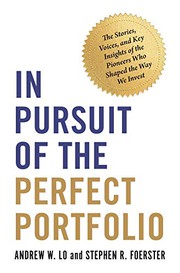
In Pursuit of the Perfect Portfolio: The Sto

In Pursuit of the Perfect Portfolio: The Stories, Voices, and Key Insights of the Pioneers Who Shaped the Way We Invest

Andrew W. Lo, Stephen R. Foerster
2021
T4 416 pages · about 6h 56m to read Open Librarygoodreads

Summary

Andrew Lo and Stephen Foerster profile ten people who shaped modern portfolio theory and its practical application, drawing on original interviews with each: Harry Markowitz, William Sharpe, Eugene Fama, John Bogle, Myron Scholes, Robert Merton, Martin Leibowitz, Robert Shiller, Charles Ellis and Jeremy Siegel. Each chapter gives the intellectual biography, explains the contribution in accessible terms, and then asks the subject directly what portfolio they would actually recommend.

The structure produces a useful tension. The theoretical chapters establish mean-variance optimisation, the capital asset pricing model, efficient markets, option pricing and the equity risk premium. The interviews then show the authors of those ideas qualifying them heavily when asked about real portfolios. Markowitz describes not using his own optimiser for his personal account. Fama and Shiller disagree about whether prices contain excess volatility, and both appear here making their case. The final chapter collects the recommendations, and the convergence toward low-cost diversified index exposure across most of the group is the book's practical conclusion.

The treatment is respectful and does not press hard on the failures, particularly Long-Term Capital Management, where Merton and Scholes were principals. The historical narrative also concentrates on a single American academic lineage and gives little space to practitioners who built portfolio methods outside it. As an introduction to where the standard toolkit came from, and to how much confidence its creators place in it, the book is unusually well sourced.

Key takeaways 7

  1. The originators of modern portfolio theory qualify their own models heavily when asked how to build a real portfolio.
  2. Mean-variance optimisation is highly sensitive to estimated expected returns, which is why practitioners constrain or discard the raw output.
  3. Fama and Shiller both won the same Nobel prize for incompatible claims about whether stock prices are excessively volatile.
  4. Bogle's contribution was organisational rather than theoretical, since the mutual ownership structure made low fees permanent.
  5. Costs and taxes are the components of return an investor can control, and every subject weights them heavily.
  6. Leibowitz's work on bond duration and immunisation made liability-driven investing possible for pension funds.
  7. Most of the ten converge on broad diversification and low cost despite disagreeing about market efficiency.

Who should read it

Investors who want the intellectual history of index investing and portfolio theory told through the people who built it, with their own current views attached.

About Andrew W. Lo

Charles E. and Susan T. Harris Professor, MIT Sloan School of Management; Director, MIT Laboratory for Financial Engineering; founder of AlphaSimplex Group

The Econometrics of Financial Markets and the variance-ratio work with MacKinlay are primary sources the field builds on, and the Adaptive Markets Hypothesis is a named framework in its own right.

MIT Sloan School of Management, MIT Laboratory for Financial Engineering, AlphaSimplex Group

Similar books 6

Chosen by shared topics, the entries that hold them, and the people who recommended both.
Peter L. Bernstein · 1992

How Markowitz, Sharpe, Fama, Black and Scholes built the theory of modern finance.

Lasse Heje Pedersen · 2015

Markets pay skilled active managers; a survey of the strategies they run.
Andrew W. Lo · 2008

Princeton University Press; revised edition 2010.
Tony Robbins · 2014

Interviews with 50 investors, from Dalio to Bogle, turned into money advice.

“…books I've recommended, highlighted to death, or forced on friends.” — Andrew Wilkinson

Source: Andrew Wilkinson's Bookshelf, neverenough.com

Recommended by: Andrew Wilkinson, Nat Eliason, Ray Dalio and 1 other

Where it sits in the reference 2

Academics
Portfolio & risk

Topics

InvestingFinance and Markets