Updates

  1. Person pages list letters, writing, profiles and links as sortable tables with filters, and show each person's companies as links; Fund letters show each letter's description in its own column.
  2. Experts show a checked job title and a short description of each person; 30 more people have photographs.
  3. Every company, fund, university and publication the experts work for has a page listing the people there.
  4. Fund letters show each letter's thesis and filter by it; 225 person pages list the essays, columns and newsletter issues the person wrote.
  5. Person pages list every essay and newsletter issue a person wrote, and their own books as a table in List view.
  6. Recommends shows the five largest kinds of book and the rest under More; browse pictures load sooner.
  7. Podcasts and talks link the original episode, filter by Audio and video or Press, and list each publisher once.
  8. Pages are wider, Recommends has List and Grid, and a filter clicked again turns off.
  9. Book cards sit in a ruled grid with Open Library and Goodreads links and each book's one-line note.
  10. Funds is now Investors; each investor's styles are buttons that filter the table.
  11. Podcasts and talks on a person's page filter by year and publisher and show as a list or a grid of pictures.
  12. Quotes show only people's own words: 472 summaries written by list sites are gone.
  13. Country pages open from Browse again, and every link on the shelf lands on a page.
  14. Subject and person pages show their sections as tabs, and each book appears once on a person's page.
  15. Book cards show the quote, who said it and the source; grids show five cards to a row.
  16. On a phone, a menu holds the sections, search, Updates, Feedback and dark mode.
  17. Feedback takes a screenshot of the page with no browser prompt, opens a screenshot full size when you click it, and clears itself once sent.
  18. Book cards are centred, search names the topic each book sits in, and any text cut short shows whole on hover.
  19. Search groups its results by kind: people, companies, geographies, subjects, topics, books, funds, fund letters and papers.
  20. The Books table lists who recommended each book by name, and the browser tab names the section you are in.
  21. Feedback can take a screenshot of the page, or one you paste or choose, and opens in the corner beside Updates.
  22. Each rail button reopens its section where you left it, and Browse, Table and People show on every book and subject page.
  23. Filters grey out choices that hold nothing instead of hiding them, and Books › People filters by authors or recommenders.
  24. Feedback takes a subject line and up to three screenshots.
  25. Biographies are grouped by the person they are about: 41 new pages, from Abraham Lincoln to Lee Kuan Yew.
  26. Sport splits into 23 sports, and Religion into one topic per faith.
  27. Book lists show as cards: the cover, one recommendation quote and every recommender by name.
  28. Seventeen subjects that had two or three pages under different names now have one page each.
  29. Every page lists its Experts as authors and recommenders, with a link to them on the Experts tab.
  30. Economics, Financial history, Financial panics and Accounting are subjects of their own, with one page per financial crisis.
  31. Book, person and subject pages open inside the app, so the tabs stay in view.
  32. 996 more book covers, and photographs or logos for 227 more people and companies.
  33. Books › Browse shows every subject as cards, and the rail holds Fund letters, Papers, Experts, Books and Funds.
  34. Every topic over 150 books splits into narrower topics, each with a page of its own.

Send feedback

What is it?
Screenshots, up to 3 (optional)
or paste one with Ctrl+V

We use your email only to reply to you.

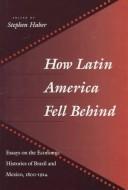
How Latin America Fell Behind

How Latin America Fell Behind

Stephen Haber
1997
T2 332 pages · about 5h 32m to read Open Librarygoodreads

Comparative essays on why Brazil and Mexico diverged from the United States.

Summary

Stephen Haber edited this collection of essays on the economic histories of Brazil and Mexico between roughly 1800 and 1914, drawn from a Stanford conference. The contributors apply the methods of new institutional economic history, asking how property rights, contract enforcement and access to credit shaped investment decisions. The comparative frame is the United States, and the question is why two large, resource-rich economies with similar starting conditions in 1800 diverged so sharply from North America over the following century.

The answers offered reject dependency theory, which attributes Latin American underdevelopment to exploitation by industrial economies through terms of trade and foreign investment. Contributors including Haber, John Coatsworth, Nathaniel Leff and Carlos Marichal argue instead that political instability after independence destroyed the fiscal capacity of the new states, that governments then financed themselves by granting monopoly privileges, and that the resulting concentration of banking and manufacturing limited entry and growth. Haber's own work on textile manufacturing shows how the small number of firms with access to credit shaped industrial structure in both countries.

The volume is academic, quantitative in places, and assumes the reader knows the outline of nineteenth-century Latin American political history. It is now one contribution among many; the later literature by Engerman and Sokoloff on factor endowments and by Acemoglu, Johnson and Robinson on colonial institutions covers overlapping ground and reaches partly different conclusions. Its value for a general reader lies in the specific mechanism it identifies linking weak states to concentrated private economies.

Key takeaways 7

  1. Latin America's divergence from North America began after independence, not during the colonial period, and political instability was the immediate cause.
  2. Governments unable to tax reliably sold monopoly rights instead, which concentrated banking and industry in a few hands.
  3. Insecure property rights raised the required return on investment, so capital went to activities with short payback periods.
  4. Dependency theory fails empirically because the periods of heaviest foreign investment coincide with the periods of fastest growth.
  5. Access to credit, rather than technology or entrepreneurship, determined which firms could enter manufacturing in Mexico and Brazil.
  6. Firms tied to the government by financial privileges lobbied to prevent the institutional reforms that would have widened credit access.
  7. Comparative colonial legacies matter less than what the successor states did with fiscal and legal institutions after 1820.

Who should read it

Investors and analysts working on emerging markets who want the institutional explanation for long-run divergence tested against two specific national histories.

Similar books 6

Chosen by shared topics, the entries that hold them, and the people who recommended both.

Javier Martínez, Alvaro Díaz · 1996

How the productive structure and business class were remade after 1973.

Sebastian Edwards · 1995

Latin America's reforms from the 1980s debt crisis to the mid-1990s, assessed.

Sebastian Edwards · 2010

Why growth kept disappointing despite reform; good on institutions and productivity.
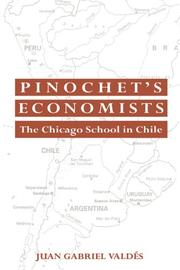
Juan Gabriel Valdés · 1995

How Chicago-trained Chilean economists came to run economic policy under Pinochet.

Sebastian Edwards · 2023

Chile's market reforms under Pinochet and their results up to the 2019 protests.

Victor Bulmer-Thomas · 1994

Latin America's economies from independence to today, period by period.

Where it sits in the reference 2

Geographies
Economics

Topics

EconomicsGeneral HistoryAsia, Africa, Latin America and the Middle East