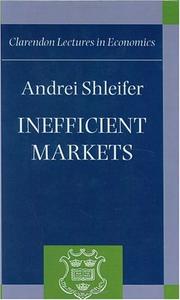
Inefficient Markets
Behavioural finance as a research programme, and why arbitrage has limits.
Summary
Shleifer presents behavioural finance as a research programme rather than as a collection of anomalies. His central theoretical contribution, developed with Robert Vishny, is the limits of arbitrage argument, which explains why mispricing persists even when sophisticated investors identify it.
The standard defence of market efficiency holds that rational arbitrageurs will correct any mispricing caused by irrational traders. Shleifer shows this fails under realistic conditions. Arbitrage requires capital, and professional arbitrageurs manage other people's money. When a mispricing widens against them, they suffer losses, their investors withdraw capital precisely when the opportunity is best, and they must liquidate rather than add. This means arbitrage capacity is smallest exactly when mispricing is largest. He adds that most real arbitrage is not riskless because close substitutes rarely exist, and that the horizon required may exceed what any fund can survive.
The empirical chapters cover closed-end fund discounts, which cannot be explained by any efficient market account, the equity premium, momentum and reversal, and the internet period, alongside the investor sentiment model he built with De Long, Summers and Waldmann.
The book is written for economists and requires the mathematics. Its argument has become standard and the limits of arbitrage framework is now used across finance. For investors the practical implication is direct: identifying a mispricing is insufficient, and the question of whether you can hold the position long enough to be paid determines whether the trade exists. The empirical material is now dated.
Key takeaways 7
- Mispricing persists because arbitrage is limited by capital, not because sophisticated investors fail to see it.
- Professional arbitrageurs manage other people's money, and their capital is withdrawn precisely when the mispricing has widened and the opportunity is best.
- Arbitrage capacity is smallest exactly when mispricing is largest, which is the reverse of what efficient market theory assumes.
- Real arbitrage is rarely riskless because close substitutes for a mispriced security usually do not exist.
- Closed-end fund discounts cannot be explained within any efficient market framework and vary with a common factor consistent with investor sentiment.
- Investor sentiment moves prices systematically rather than randomly, which means noise trader risk is itself a priced risk.
- Identifying a mispricing is insufficient for a trade, since whether you can hold the position long enough to be paid determines whether the opportunity is real.
Who should read it
Investors and finance students who need the theoretical account of why mispricings persist and what that implies for holding contrarian positions.
Who recommended it 1 · 1 direct
“The Rules of the Game In his excellent book, Inefficient Markets, Harvard professor Andrei Shleifer summarizes the three arguments that underpin the efficient market hypothesis (EMH): 5 1.”
Similar books 6
Chosen by shared topics, the entries that hold them, and the people who recommended both.
Research papers showing that stock prices do not follow a random walk.
“Andrew W. Lo and A. Craig MacKinlay, A Non-Random Walk Down Wall Street (Princeton, NJ: Princeton University Press, 1999), 4-5” — Michael Mauboussin
Source: Capital Ideas Revisited - Part 2: Thoughts on Beating a Mostly-Efficient Stock Market, page 9
Recommended by: Michael Mauboussin
The adaptive markets hypothesis, joining efficient markets and behavioural finance.
“Lo, Andrew W., Adaptive Markets: Financial Evolution at the Speed of Thought (Princeton, NJ: Princeton University Press, 2017)” — Michael Mauboussin
Source: Who Is On the Other Side? You Need Good BAIT to Land a Winner, page 40
Recommended by: Michael Mauboussin
How financial economics changed the markets it set out to describe.
“There’s a wonderful chapter about LTCM in “An Engine, Not a Camera: How Financial Models Shape Markets” by Donald MacKenzie, a professor of sociology at the University of Edinburgh.15 The most recent issue of a bond is called on-the-run.” — Michael Mauboussin
Source: Animating Mr. Market: Adopting a Proper Psychological Attitude, page 6
Recommended by: Michael Mauboussin

How Markowitz, Sharpe, Fama, Black and Scholes built the theory of modern finance.
“But it was in his Capital Ideas, published in 1992, that I first learned of Louis Bachelier’s 1900 dissertation, The Theory of Speculation.” — John C. Bogle
Source: Success In Investment Management: What Can We Learn From Indexing?, page 1
Recommended by: John C. Bogle, Michael Mauboussin
Markets pay skilled active managers; a survey of the strategies they run.
“Now another outstanding Nordic researcher (and AQR partner), Lasse Heje Pedersen, presents me with the same dilemma: His new book, Efficiently Inefficient (Princeton University Press), is fantastic — almost too good at laying out how successful professional asset managers think and act.” — Clifford Asness
Source: Efficient Inefficiency: The Oxymoron That Explains the Investing World
Recommended by: Clifford Asness, Michael Mauboussin
A formal model of markets whose efficiency shifts as participants adapt.
“Andrew W. Lo and Ruixun Zhang, The Adaptive Markets Hypothesis: An Evolutionary Approach to Understanding Financial System Dynamics (Oxford: Oxford University Press, 2024)” — Michael Mauboussin
Source: Who Is On the Other Side? A Framework for Understanding Market (In)Efficiency
Recommended by: Michael Mauboussin