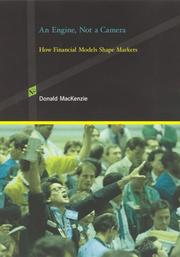
An Engine, Not a Camera
How financial economics changed the markets it set out to describe.
Summary
MacKenzie, a sociologist of science, argues that financial economics did not merely describe markets, it changed them. His central concept is performativity: a theory is performative when its use alters the world so that the world comes to resemble the theory.
His principal case is the Black-Scholes-Merton option pricing model. MacKenzie shows that before its publication, observed option prices differed substantially from what the model implied, and that after traders adopted it, prices converged toward the model's predictions. The convergence happened because traders used the model to identify and trade away discrepancies, and because the Chicago Board Options Exchange distributed model-derived sheets to floor traders. The theory made itself true. He documents the process through interviews with participants and through price data.
He covers the wider history of financial economics including Markowitz, Modigliani and Miller, Sharpe, Fama and the efficient market work, and treats each as an intervention in markets rather than only a description of them. He also examines the reverse case: the 1987 crash, after which the volatility smile appeared and never disappeared, meaning the market permanently stopped conforming to the model. He calls this counterperformativity, where use of a theory makes it less true. Long-Term Capital Management gets similar treatment.
The book is a scholarly work in science studies and is written for that audience, though the finance is explained clearly. Its argument is genuinely important for investors: models used widely enough change what they are modelling.
Key takeaways 7
- A theory is performative when its use changes the world so that the world comes to resemble the theory, and financial economics has repeatedly done this.
- Observed option prices differed substantially from Black-Scholes before its adoption and converged toward it afterwards, because traders used the model to arbitrage discrepancies.
- The Chicago Board Options Exchange distributed model-derived price sheets to floor traders, which is a concrete mechanism by which a theory entered prices.
- Financial models used widely enough change what they are modelling, which means their empirical validation is partly self-generated.
- The volatility smile that appeared after 1987 and never disappeared is evidence of counterperformativity, where use of a model made it less accurate.
- Portfolio insurance failed because widespread adoption of the same hedging rule created the correlated selling the rule assumed would not occur.
- Financial theory should be understood as an intervention in markets rather than as a description of them, which changes how its empirical record should be read.
Who should read it
Investors and quantitative practitioners who need to understand how widely adopted models change the markets they describe.
Who recommended it 1 · 1 direct
“There’s a wonderful chapter about LTCM in “An Engine, Not a Camera: How Financial Models Shape Markets” by Donald MacKenzie, a professor of sociology at the University of Edinburgh.15 The most recent issue of a bond is called on-the-run.”
Similar books 6
Chosen by shared topics, the entries that hold them, and the people who recommended both.
Behavioural finance as a research programme, and why arbitrage has limits.
“The Rules of the Game In his excellent book, Inefficient Markets, Harvard professor Andrei Shleifer summarizes the three arguments that underpin the efficient market hypothesis (EMH): 5 1.” — Michael Mauboussin
Source: Contrarian Investing: The Psychology of Going Against the Crowd, page 2
Recommended by: Michael Mauboussin
A formal model of markets whose efficiency shifts as participants adapt.
“Andrew W. Lo and Ruixun Zhang, The Adaptive Markets Hypothesis: An Evolutionary Approach to Understanding Financial System Dynamics (Oxford: Oxford University Press, 2024)” — Michael Mauboussin
Source: Who Is On the Other Side? A Framework for Understanding Market (In)Efficiency
Recommended by: Michael Mauboussin
The rise and fall of the efficient market theory and the modern finance it built.
“Fox, Justin, The Myth of the Rational Market: A History of Risk, Reward, and Delusion on Wall Street (New York: HarperCollins, 2009)” — Michael Mauboussin
Source: Who Is On the Other Side? A Framework for Understanding Market (In)Efficiency
Recommended by: Michael Mauboussin, Mohnish Pabrai
Proposals for markets to hedge the largest risks households and countries face.
Why global markets are unstable, written after the Asian and Russian crises.
How finance could insure people against the large risks in their lives.
Recommended by: Nassim Nicholas Taleb