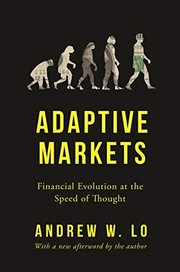
Adaptive Markets: Financial Evolution at the Speed of Thought
The adaptive markets hypothesis, joining efficient markets and behavioural finance.
Summary
Lo, an MIT finance professor, proposes the adaptive markets hypothesis as a reconciliation of efficient markets theory with behavioural finance. His claim is that market efficiency is not a fixed property but depends on the environment: the number and variety of participants, the resources available to them, and the profitability of the opportunities present.
The framework treats investors as adaptive rather than rational or irrational. Behaviour that appears irrational is generally a heuristic that was adaptive in a different environment, and the mismatch between the heuristic and the current environment produces the observed anomaly. Markets become efficient when many participants with diverse strategies compete for opportunities, and become inefficient when the participant population changes, when a strategy becomes crowded, or when conditions shift faster than participants can adapt.
He supports this with neuroscience on decision-making under stress, evolutionary biology on how heuristics develop, and empirical work on the time-varying nature of return predictability. He also draws on his own research on hedge fund returns, liquidity and systemic risk, including his analysis of the August 2007 quantitative fund unwinding.
The practical implications he draws are that risk premia vary over time rather than being constant, that strategies decay as they become crowded, and that regulation should be adaptive rather than fixed.
The main criticism is that the hypothesis is difficult to falsify, since almost any market behaviour can be described as adaptation to an environment. Lo acknowledges this. The book is long and includes considerable digression, and the framework is more useful as a way of organising thinking than as a testable theory.
Key takeaways 7
- Market efficiency is a variable property of an environment rather than a fixed characteristic, and it changes with the number and diversity of participants.
- Behaviour that appears irrational is usually a heuristic that was adaptive in a different environment and is mismatched to the current one.
- Risk premia vary over time rather than being constant, which means any strategy calibrated to a historical premium will fail when conditions change.
- Investment strategies decay as they become crowded, because the participants exploiting an opportunity are what removes it.
- The relationship between risk and return is not stable, so asset allocation based on long-run historical averages is calibrated to a regime that may not recur.
- Competition among diverse strategies is what produces efficiency, and convergence of participants onto similar strategies produces fragility.
- Financial regulation should adapt as the ecology of participants changes, since fixed rules become mismatched to the behaviour they govern.
Who should read it
Investors who want a framework reconciling efficient markets with observed anomalies and an argument for treating risk premia as time-varying.
About Andrew W. Lo
Charles E. and Susan T. Harris Professor, MIT Sloan School of Management; Director, MIT Laboratory for Financial Engineering; founder of AlphaSimplex Group
The Econometrics of Financial Markets and the variance-ratio work with MacKinlay are primary sources the field builds on, and the Adaptive Markets Hypothesis is a named framework in its own right.
Who recommended it 1 · 1 direct
“Lo, Andrew W., Adaptive Markets: Financial Evolution at the Speed of Thought (Princeton, NJ: Princeton University Press, 2017)”
Similar books 6
Chosen by shared topics, the entries that hold them, and the people who recommended both.
Research papers showing that stock prices do not follow a random walk.
“Andrew W. Lo and A. Craig MacKinlay, A Non-Random Walk Down Wall Street (Princeton, NJ: Princeton University Press, 1999), 4-5” — Michael Mauboussin
Source: Capital Ideas Revisited - Part 2: Thoughts on Beating a Mostly-Efficient Stock Market, page 9
Recommended by: Michael Mauboussin
A formal model of markets whose efficiency shifts as participants adapt.
“Andrew W. Lo and Ruixun Zhang, The Adaptive Markets Hypothesis: An Evolutionary Approach to Understanding Financial System Dynamics (Oxford: Oxford University Press, 2024)” — Michael Mauboussin
Source: Who Is On the Other Side? A Framework for Understanding Market (In)Efficiency
Recommended by: Michael Mauboussin
The statistical tools of empirical finance and the questions they test.
“Campbell, John Y., Andrew W. Lo, and A. Craig MacKinley, The Econometrics of Financial Markets (Princeton, NJ: Princeton University Press, 1996)” — Michael Mauboussin
Source: Capital Ideas Revisited: The Prime Directive, Sharks, and The Wisdom of Crowds, page 16
Recommended by: Michael Mauboussin, William J. Bernstein

How Markowitz, Sharpe, Fama, Black and Scholes built the theory of modern finance.
“But it was in his Capital Ideas, published in 1992, that I first learned of Louis Bachelier’s 1900 dissertation, The Theory of Speculation.” — John C. Bogle
Source: Success In Investment Management: What Can We Learn From Indexing?, page 1
Recommended by: John C. Bogle, Michael Mauboussin
Markets pay skilled active managers; a survey of the strategies they run.
“Now another outstanding Nordic researcher (and AQR partner), Lasse Heje Pedersen, presents me with the same dilemma: His new book, Efficiently Inefficient (Princeton University Press), is fantastic — almost too good at laying out how successful professional asset managers think and act.” — Clifford Asness
Source: Efficient Inefficiency: The Oxymoron That Explains the Investing World
Recommended by: Clifford Asness, Michael Mauboussin
Research on how hedge fund returns and risks behave, and how to measure them.
“Andrew W. Lo, Hedge Funds: An Analytic Perspective (Princeton, NJ: Princeton University Press, 2008), 255-302” — Michael Mauboussin
Source: Long-Term Investing: How I Learned to Stop Worrying and Ignore Volatility, page 6
Recommended by: Michael Mauboussin