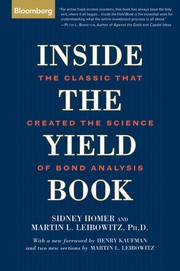
Inside the Yield Book
Written by Salomon's own research chiefs; the firm's lasting intellectual output.
Summary
Homer and Leibowitz wrote the book that made bond mathematics accessible and usable, and it remains the standard practitioner text on fixed income analytics. It was written when bond yields were calculated from printed tables, which is what the title refers to.
The core content covers the mathematics of bond pricing and its practical consequences. They work through the relationship between price and yield, why the relationship is convex rather than linear, and what that convexity means for a portfolio. They explain duration as a measure of price sensitivity and as a measure of the effective time to repayment, and show why duration rather than maturity is the correct measure of interest rate exposure. They introduce the concept of total return over a holding period, decomposed into coupon income, reinvestment income and price change, and demonstrate that reinvestment of coupons at uncertain future rates is a large and underappreciated share of a long bond's realised return, which they called interest on interest.
The later chapters cover bond swaps, meaning the exchange of one bond for another to improve yield, spread or duration, and the analysis of when such a swap is worthwhile over a defined horizon.
The book has been reissued with additional Leibowitz material. Its mathematics has not changed and the intuitions it builds, particularly about duration, convexity and reinvestment risk, are the foundation of fixed income management. The market institutions described are of their period and the treatment predates modern derivatives, credit analytics and negative rates.
Key takeaways 7
- Duration rather than maturity measures a bond's sensitivity to interest rate changes, and two bonds with the same maturity can have very different exposure.
- The price-yield relationship is convex, which means a bond gains more from a fall in yields than it loses from an equal rise.
- Reinvestment of coupons at uncertain future rates accounts for a large share of a long-dated bond's realised total return.
- A bond's realised return over a holding period depends on the reinvestment rate as much as on the purchase yield, which makes the quoted yield an incomplete measure.
- Total return over a defined horizon, not yield to maturity, is the correct basis for comparing bonds.
- Bond swaps should be evaluated over a specific holding horizon with explicit reinvestment assumptions, since the answer changes with both.
- Longer duration increases both the gain from falling yields and the loss from rising ones, which makes duration the primary portfolio decision in fixed income.
Who should read it
Fixed income investors who need the foundational intuitions about duration, convexity and reinvestment risk from the text that established them.
About Sidney Homer
Founded the bond market research department at Salomon Brothers and wrote the standard history of interest rates; died in 1983.
A History of Interest Rates assembles rate series from Babylonian loans through the twentieth century and is the only long-run record of what money has cost across monetary regimes, which is why every argument about whether current rates are high or low ends up citing it. Inside the Yield Book, with Martin Leibowitz, introduced total-return analysis of bonds and the arithmetic of duration and reinvestment that fixed income desks still use.
Similar books 6
Chosen by shared topics, the entries that hold them, and the people who recommended both.
Interest rates from Babylonian lending through Rome and Europe to modern bonds.
Recommended by: Mohnish Pabrai
Life on Salomon Brothers' bond trading floor in the 1980s mortgage-bond boom.
“I do believe, as Michael Lewis writes in his intriguing 1989 book, "Liar's Poker," that it is unlikely that an individual unable to buck convention in one's life will suddenly be able to buck…” — Michael Burry
Source: MSN Money Strategy Lab journal, March 2, 2001 — archived
Recommended by: Michael Burry, Mohnish Pabrai, Nat Eliason and 3 others
The standard text on bonds: instruments, valuation, risk and portfolio strategy.
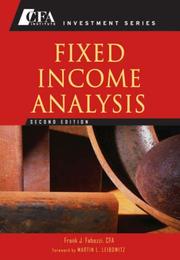
The CFA Institute's fixed-income text: bond valuation, risk and analysis.

Practical guide to trading rates, swaps and futures.
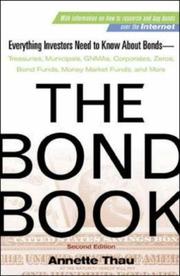
Retail-investor guide with the clearest chapters on buying munis.
Where it sits in the reference 3
Topics