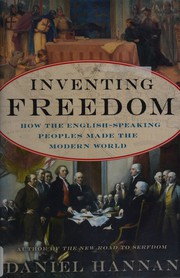
Inventing Freedom: How the English-Speaking Peoples Made the Modern World
How English-speaking peoples spread representative government and personal freedom.
Summary
Daniel Hannan asks why the world speaks English and why almost every country at least pretends to want representative government, personal freedom and an independent judiciary. He gives an account of the origin and spread of those principles and their role in creating a sphere of economic and political liberty that he regards as both essential and under threat.
The ideas and institutions considered essential to freedom, he argues, namely individual rights, private property, the rule of law and representative government, are not broadly "Western" but the legacy of a specific tradition born in England and inherited by the Americans and other former British colonies. By the tenth century, a thousand years before most modern countries, England was a nation-state whose people were beginning to define themselves by common-law rights. Hannan explains why the idea that the state is the servant of the individual, not his ruler, developed uniquely in the English-speaking world, and the publisher calls the book a chronicle of Anglosphere exceptionalism.
Key takeaways 4
- Hannan traces modern liberty to a specifically English tradition.
- Common law, property rights and representative government developed early in England.
- The United States and other former colonies inherited that tradition.
- The state as servant of the individual is, in his view, an Anglosphere idea.
Who should read it
Readers of political and constitutional history interested in the origins of liberal institutions.
Who recommended it 1 · 1 direct
Similar books 6
Chosen by shared topics, the entries that hold them, and the people who recommended both.
A conservative history of antifascism, from early twentieth-century Europe to the US.
Recommended by: Marc Andreessen
What fascism was, against its use as a synonym for Nazism.
Recommended by: Marc Andreessen
The political repression of communist states, documented country by country.
Recommended by: Nick Szabo
Fascism and Nazism explained as fundamental revolutions.
Recommended by: Jim Collins

How growing equality of conditions shaped American democracy and society.
Recommended by: Jim Collins, Patrick Collison, Li Lu