Updates

  1. Every US-listed company has a page with its SEC filings. Company pages list their experts and their management, past and present. Fund managers sit under Investors. Each show has a page of its episodes, and an episode page names its guests and hosts. Biographies lists groups, then people. Breadcrumbs show where a page sits.
  2. Media lists every podcast episode, video, interview and talk, over 10,000, by person, company, publisher and event; each filter searches its own choices. Books opens on its table, then Browse, then Authors and Recommenders. A filter's count no longer covers its arrow.
  3. A book that no company, country or subject page lists shows its topics under Where it sits in the reference. On a phone, a page's tabs scroll sideways only. Descriptions read the same on every page. See them in the Experts tab lists every expert the page names.
  4. Every podcast episode, video and interview has its own page with a video or audio player and a link to the source. Investor pages show each company's sector and market cap; firms such as Berkshire Hathaway have one page that holds their letters and their company tabs. Letters tabs filter by company and search the theses. Companies filter by Public, Private and Defunct and link each company's website.
  5. Every tab, view and search has its own address, such as /books/table/asset or /letters/companies, so Back works and a link opens the same place. Page addresses no longer end in .html. Fund letters, Investors, Companies and Papers load about a fifth of the data they did.
  6. Fund letters has a Companies tab: every company the letters name, with its market cap, sector, country, and how many letters and investors name it. Investor pages link each investor's website. Lists in table cells end with “… and N more” at every width.
  7. 1,120 more book summaries; descriptions for 373 papers; pages for 137 more companies, each with the fund letters that discuss it; 215 official photographs; search has its own page.
  8. 411 more books have a summary; person pages list 930 more of the books they wrote; 147 people show their official photograph.
  9. Every investor has a page with its letters and the companies they discuss; company pages list the investors whose letters name them.
  10. A Companies section at the top of the rail lists every company the books, experts and fund letters name.
  11. Person pages list letters, writing, profiles and links as sortable tables with filters, and show each person's companies as links; Fund letters show each letter's description in its own column.
  12. Experts show a checked job title and a short description of each person; 30 more people have photographs.
  13. Every company, fund, university and publication the experts work for has a page listing the people there.
  14. Fund letters show each letter's thesis and filter by it; 225 person pages list the essays, columns and newsletter issues the person wrote.
  15. Person pages list every essay and newsletter issue a person wrote, and their own books as a table in List view.
  16. Recommends shows the five largest kinds of book and the rest under More; browse pictures load sooner.
  17. Podcasts and talks link the original episode, filter by Audio and video or Press, and list each publisher once.
  18. Pages are wider, Recommends has List and Grid, and a filter clicked again turns off.
  19. Book cards sit in a ruled grid with Open Library and Goodreads links and each book's one-line note.
  20. Funds is now Investors; each investor's styles are buttons that filter the table.
  21. Podcasts and talks on a person's page filter by year and publisher and show as a list or a grid of pictures.
  22. Quotes show only people's own words: 472 summaries written by list sites are gone.
  23. Country pages open from Browse again, and every link on the shelf lands on a page.
  24. Subject and person pages show their sections as tabs, and each book appears once on a person's page.
  25. Book cards show the quote, who said it and the source; grids show five cards to a row.
  26. On a phone, a menu holds the sections, search, Updates, Feedback and dark mode.
  27. Feedback takes a screenshot of the page with no browser prompt, opens a screenshot full size when you click it, and clears itself once sent.
  28. Book cards are centred, search names the topic each book sits in, and any text cut short shows whole on hover.
  29. Search groups its results by kind: people, companies, geographies, subjects, topics, books, funds, fund letters and papers.
  30. The Books table lists who recommended each book by name, and the browser tab names the section you are in.
  31. Feedback can take a screenshot of the page, or one you paste or choose, and opens in the corner beside Updates.
  32. Each rail button reopens its section where you left it, and Browse, Table and People show on every book and subject page.
  33. Filters grey out choices that hold nothing instead of hiding them, and Books › People filters by authors or recommenders.
  34. Feedback takes a subject line and up to three screenshots.
  35. Biographies are grouped by the person they are about: 41 new pages, from Abraham Lincoln to Lee Kuan Yew.
  36. Sport splits into 23 sports, and Religion into one topic per faith.
  37. Book lists show as cards: the cover, one recommendation quote and every recommender by name.
  38. Seventeen subjects that had two or three pages under different names now have one page each.
  39. Every page lists its Experts as authors and recommenders, with a link to them on the Experts tab.
  40. Economics, Financial history, Financial panics and Accounting are subjects of their own, with one page per financial crisis.
  41. Book, person and subject pages open inside the app, so the tabs stay in view.
  42. 996 more book covers, and photographs or logos for 227 more people and companies.
  43. Books › Browse shows every subject as cards, and the rail holds Fund letters, Papers, Experts, Books and Funds.
  44. Every topic over 150 books splits into narrower topics, each with a page of its own.

Send feedback

What is it?
Screenshots, up to 3 (optional)
or paste one with Ctrl+V

We use your email only to reply to you.

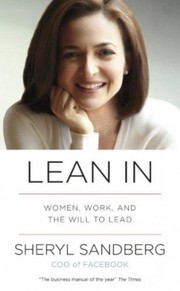
Lean In: Women, Work, and the Will to Lead

Lean In: Women, Work, and the Will to Lead

Why few women reach senior roles, and what women and firms can do about it.

Sheryl Sandberg
2013
T4 292 pages · about 4h 52m to read Open Librarygoodreads

Summary

Sandberg, then Facebook's chief operating officer, argues that women's underrepresentation in senior positions results from both external barriers and from internal patterns that women can address directly, and she concentrates on the second while acknowledging the first.

Her specific claims include that women systematically underestimate their own capability and apply for roles only when they meet all stated requirements while men apply meeting a fraction; that women are penalised socially for the assertiveness that produces advancement, which is a documented likeability and success trade-off that men do not face; that women begin withdrawing from career advancement in anticipation of children years before having them, which she calls leaving before you leave; that the choice of a partner is the most consequential career decision a woman makes, since domestic labour distribution determines what is possible; and that mentorship should be earned through performance rather than requested directly.

She draws on research including the Heidi and Howard case study, in which identical résumés with different names produced different assessments of likeability, and on data about negotiation outcomes and about domestic labour distribution.

The book received substantial criticism for concentrating on individual behaviour rather than on structural and policy change, for generalising from an unusually privileged position, and for placing responsibility on women for a problem created by institutions. bell hooks and others made this case forcefully. Sandberg addressed some of it afterwards, particularly regarding single parents and women without resources. The research findings on the likeability penalty and on self-assessment are well supported.

Key takeaways 8

  1. Women systematically underestimate their own performance and apply for roles only when meeting all stated requirements, while men apply meeting a fraction of them.
  2. Success and likeability correlate positively for men and negatively for women, which is documented experimentally and imposes a cost on assertiveness.
  3. Women begin withdrawing from advancement in anticipation of children years before having them, which forecloses options before any decision is required.
  4. The choice of partner is the most consequential career decision, since the distribution of domestic labour determines what is possible professionally.
  5. Sitting at the table rather than at the edge of the room is Sandberg's shorthand for the physical and behavioural patterns that signal exclusion from decisions.
  6. Mentorship should be earned through performance rather than requested directly, since a request for mentorship is a request for unpaid work.
  7. Negotiating on behalf of others produces better outcomes for women than negotiating for themselves, which reflects how assertiveness is received.
  8. The book concentrates on individual behaviour rather than on structural change, which is the criticism its author has partly accepted.

Who should read it

Women navigating corporate advancement and managers examining their own assessment practices, with the structural criticisms understood.

Who recommended it 5 · 2 direct

Julie Zhuoreported

Similar books 6

Chosen by shared topics, the entries that hold them, and the people who recommended both.
Joann S. Lublin · 2016

Recommended by: Ginni Rometty

Where it sits in the reference 2

Business themes
Business themes

Topics 3

Business and ManagementSociology and CultureRace, gender and identity