Updates

  1. Every US-listed company has a page with its SEC filings. Company pages list their experts and their management, past and present. Fund managers sit under Investors. Each show has a page of its episodes, and an episode page names its guests and hosts. Biographies lists groups, then people. Breadcrumbs show where a page sits.
  2. Media lists every podcast episode, video, interview and talk, over 10,000, by person, company, publisher and event; each filter searches its own choices. Books opens on its table, then Browse, then Authors and Recommenders. A filter's count no longer covers its arrow.
  3. A book that no company, country or subject page lists shows its topics under Where it sits in the reference. On a phone, a page's tabs scroll sideways only. Descriptions read the same on every page. See them in the Experts tab lists every expert the page names.
  4. Every podcast episode, video and interview has its own page with a video or audio player and a link to the source. Investor pages show each company's sector and market cap; firms such as Berkshire Hathaway have one page that holds their letters and their company tabs. Letters tabs filter by company and search the theses. Companies filter by Public, Private and Defunct and link each company's website.
  5. Every tab, view and search has its own address, such as /books/table/asset or /letters/companies, so Back works and a link opens the same place. Page addresses no longer end in .html. Fund letters, Investors, Companies and Papers load about a fifth of the data they did.
  6. Fund letters has a Companies tab: every company the letters name, with its market cap, sector, country, and how many letters and investors name it. Investor pages link each investor's website. Lists in table cells end with “… and N more” at every width.
  7. 1,120 more book summaries; descriptions for 373 papers; pages for 137 more companies, each with the fund letters that discuss it; 215 official photographs; search has its own page.
  8. 411 more books have a summary; person pages list 930 more of the books they wrote; 147 people show their official photograph.
  9. Every investor has a page with its letters and the companies they discuss; company pages list the investors whose letters name them.
  10. A Companies section at the top of the rail lists every company the books, experts and fund letters name.
  11. Person pages list letters, writing, profiles and links as sortable tables with filters, and show each person's companies as links; Fund letters show each letter's description in its own column.
  12. Experts show a checked job title and a short description of each person; 30 more people have photographs.
  13. Every company, fund, university and publication the experts work for has a page listing the people there.
  14. Fund letters show each letter's thesis and filter by it; 225 person pages list the essays, columns and newsletter issues the person wrote.
  15. Person pages list every essay and newsletter issue a person wrote, and their own books as a table in List view.
  16. Recommends shows the five largest kinds of book and the rest under More; browse pictures load sooner.
  17. Podcasts and talks link the original episode, filter by Audio and video or Press, and list each publisher once.
  18. Pages are wider, Recommends has List and Grid, and a filter clicked again turns off.
  19. Book cards sit in a ruled grid with Open Library and Goodreads links and each book's one-line note.
  20. Funds is now Investors; each investor's styles are buttons that filter the table.
  21. Podcasts and talks on a person's page filter by year and publisher and show as a list or a grid of pictures.
  22. Quotes show only people's own words: 472 summaries written by list sites are gone.
  23. Country pages open from Browse again, and every link on the shelf lands on a page.
  24. Subject and person pages show their sections as tabs, and each book appears once on a person's page.
  25. Book cards show the quote, who said it and the source; grids show five cards to a row.
  26. On a phone, a menu holds the sections, search, Updates, Feedback and dark mode.
  27. Feedback takes a screenshot of the page with no browser prompt, opens a screenshot full size when you click it, and clears itself once sent.
  28. Book cards are centred, search names the topic each book sits in, and any text cut short shows whole on hover.
  29. Search groups its results by kind: people, companies, geographies, subjects, topics, books, funds, fund letters and papers.
  30. The Books table lists who recommended each book by name, and the browser tab names the section you are in.
  31. Feedback can take a screenshot of the page, or one you paste or choose, and opens in the corner beside Updates.
  32. Each rail button reopens its section where you left it, and Browse, Table and People show on every book and subject page.
  33. Filters grey out choices that hold nothing instead of hiding them, and Books › People filters by authors or recommenders.
  34. Feedback takes a subject line and up to three screenshots.
  35. Biographies are grouped by the person they are about: 41 new pages, from Abraham Lincoln to Lee Kuan Yew.
  36. Sport splits into 23 sports, and Religion into one topic per faith.
  37. Book lists show as cards: the cover, one recommendation quote and every recommender by name.
  38. Seventeen subjects that had two or three pages under different names now have one page each.
  39. Every page lists its Experts as authors and recommenders, with a link to them on the Experts tab.
  40. Economics, Financial history, Financial panics and Accounting are subjects of their own, with one page per financial crisis.
  41. Book, person and subject pages open inside the app, so the tabs stay in view.
  42. 996 more book covers, and photographs or logos for 227 more people and companies.
  43. Books › Browse shows every subject as cards, and the rail holds Fund letters, Papers, Experts, Books and Funds.
  44. Every topic over 150 books splits into narrower topics, each with a page of its own.

Send feedback

What is it?
Screenshots, up to 3 (optional)
or paste one with Ctrl+V

We use your email only to reply to you.

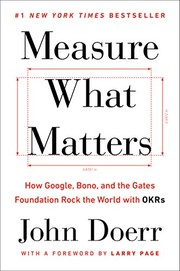
Measure What Matters

Measure What Matters

Objectives and key results, the goal system Grove built at Intel and Google adopted.

John Doerr
2017
T2 320 pages · about 5h 20m to read Open Librarygoodreads

OKRs as Doerr learned them at Intel and spread through venture portfolios

Summary

Doerr documents objectives and key results, the goal-setting system Andy Grove developed at Intel and that Doerr introduced to Google in 1999 as a venture investor. An objective is a qualitative statement of what is to be achieved. Key results are quantitative measures that determine whether it was achieved, typically three to five per objective, with numbers and deadlines.

The operating rules Doerr sets out include making objectives public across the organisation so anyone can see what anyone else is working on; setting them quarterly and annually; separating committed objectives, which must be fully achieved, from aspirational ones, where achieving seventy percent counts as success; setting them both top down and bottom up rather than cascading them entirely from the top; and decoupling them from compensation so that people set ambitious targets without financial risk.

The second half covers what Doerr calls continuous performance management, meaning conversations, feedback and recognition, and argues that annual performance reviews should be replaced by regular one-on-ones structured around progress against key results.

The evidence is a series of case studies from Google, Intel, YouTube, the Gates Foundation, Bono's ONE campaign, Intuit and others, all presented as successes. Doerr does not examine organisations where the system failed, and the number of companies that adopted objectives and key results and abandoned them is substantial. The system's dependence on decoupling from compensation is the rule most often broken in practice, which converts ambitious targets into sandbagged ones. The book is repetitive and reads partly as advocacy. The mechanics are stated clearly enough to implement.

Key takeaways 8

  1. An objective states what is to be achieved qualitatively, and key results measure whether it was achieved with numbers and dates.
  2. Goals should be visible to everyone in the organisation, because transparency is what allows teams to see dependencies and avoid duplicated effort.
  3. Committed and aspirational objectives are different categories, and mixing them destroys both by making failure ambiguous.
  4. Aspirational objectives should be set so that achieving seventy percent counts as success, which is what makes ambitious targets safe to set.
  5. Goal setting must run bottom up as well as top down, and organisations that cascade objectives entirely from the top produce compliance rather than commitment.
  6. Objectives must be decoupled from compensation, because tying them to pay guarantees that people will set targets they know they can hit.
  7. A small number of objectives forces the prioritisation that the exercise exists to produce, and organisations that set many have not chosen.
  8. Regular conversations about progress should replace annual performance reviews, which arrive too late to change any outcome.

Who should read it

Executives implementing a company-wide goal system who need the operating rules, particularly the separation of aspirational goals from compensation.

About John Doerr

Chairman of the venture firm Kleiner Perkins, where he led investments in Google, Amazon, Intuit and Sun Microsystems.

Measure What Matters documents the objectives-and-key-results system Andy Grove built at Intel and Doerr carried into Google, with the mechanics that make it work - how objectives are set, how key results are graded, and why they are kept separate from compensation. Speed and Scale applies the same goal structure to decarbonisation targets and to the climate companies venture investors now fund.

Who recommended it 7 · 1 direct

Amy Hoodreported
Craig Blairreported
Larry Pagereported
Reid Hoffmanreported

Similar books 6

Chosen by shared topics, the entries that hold them, and the people who recommended both.
Jeremy Hope, Robin Fraser · 2003

Why the annual budget harms firms, and how some run without one.
Bob Fifer · 1994

Cost discipline handbook widely used by buyout and turnaround operators

Robert S. Kaplan, David P. Norton · 1996

Measure a firm on finance, customers, internal processes, and learning and growth.

Recommended by: Mohnish Pabrai
Eliyahu M. Goldratt, Jeff Cox · 1984

A plant manager learns that a system's output is set by its bottleneck.

Ken Iverson · 1997

Nucor's chief executive on flat structure, incentive pay and minimills

Recommended by: Francois Rochon
Where it sits in the reference 4

Investors
Accounting
Business themes
Business themes

Topics 2

Business and ManagementLeadership