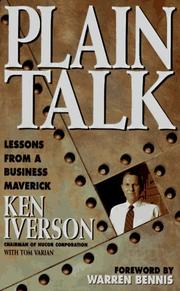
Plain Talk: Lessons from a Business Maverick
How Nucor became a steel giant with minimills, flat structure and incentive pay.
Nucor's chief executive on flat structure, incentive pay and minimills
Summary
Iverson ran Nucor from 1965 to 1998 and built it from a near-bankrupt conglomerate into one of the largest American steel producers, using electric arc minimills that produced steel from scrap while the integrated producers used blast furnaces and iron ore.
The management structure is the substance and it is extreme. Nucor had four management layers between the chief executive and the front line, against a dozen or more at competitors. The head office employed around two dozen people for a company of seven thousand. There were no company cars, no executive dining rooms, no reserved parking, no corporate jet and no assigned offices for executives. Everyone flew economy including Iverson. Every employee received the same insurance and the same holiday arrangements.
The compensation system paid production workers a low base wage plus a bonus based on the output of their shift group, calculated weekly and paid weekly, which produced total earnings well above industry averages in good periods and substantially below in bad ones. Managers and executives had a larger proportion of their pay at risk than production workers did, and in downturns executive pay fell by a larger percentage than anyone else's.
His stated position is that layers of management exist to control people who are assumed to be untrustworthy, and that removing the assumption removes the need for the layers. The book is short and Iverson's own account. Nucor operated in a commodity business where output was measurable, which is what made the bonus system possible. The compensation structure and the layer reduction are the transferable elements.
Key takeaways 8
- Nucor operated with four management layers between the chief executive and the front line, against a dozen or more at competitors.
- The head office employed around two dozen people for a company of seven thousand, which forced decisions to be made in the operations.
- Production workers received a low base wage plus a weekly bonus based on their shift group's output, calculated and paid weekly.
- Executive pay had a larger proportion at risk than production workers' pay, and fell by a larger percentage in downturns.
- Eliminating executive privileges including cars, dining rooms, reserved parking and assigned offices removed the visible distinction between levels.
- Management layers exist to control people assumed to be untrustworthy, and removing the assumption removes the need for the layers.
- Adopting a new production technology, in this case the electric arc minimill, allowed a small company to displace far larger integrated producers.
- The bonus system depended on output being measurable at the group level, which is what made the approach possible in this specific business.
Who should read it
Executives interested in radical layer reduction and in output-based compensation, from a company that ran both for three decades.
Who recommended it 2 · 2 direct
Similar books 6
Chosen by shared topics, the entries that hold them, and the people who recommended both.
How Caterpillar went from losing a million dollars a day to strong performance.
Recommended by: Mohnish Pabrai
How POSCO, the Korean steelmaker, was built from nothing into a world producer.
Recommended by: Mohnish Pabrai
How Pixar kept a creative company working after success, and the habits it used.
“His book, Creativity, Inc.; an amazing, amazing book.” — Ezra Klein
Source: The Tim Ferriss Show Transcripts: Ezra Klein (#208)
Recommended by: Ezra Klein, Jim Collins, Michael Mauboussin and 12 others
Five disciplines, led by systems thinking, that let an organisation learn.
Recommended by: Jim Collins, Mohnish Pabrai, Sahil Lavingia and 1 other
Ideas for empowering employees: self-directed teams, initiative and risk.
Recommended by: Mohnish Pabrai
Rewards of every kind for employees, gathered from American businesses.
Recommended by: Mohnish Pabrai