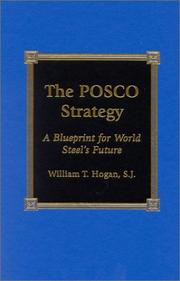
The POSCO Strategy
How POSCO, the Korean steelmaker, was built from nothing into a world producer.
Summary
The reference has not verified this book in detail; the summary states only what the title, author and subject establish.
Hogan was an economist who spent his career studying the steel industry, and he wrote this account of Pohang Iron and Steel Company, the Korean producer founded in 1968 that became one of the largest and lowest-cost steelmakers in the world. The book covers the company's founding, its construction programme and its competitive position around 2000.
The central claim concerns the advantage of building new. POSCO was created from nothing on greenfield sites at Pohang and later Gwangyang, financed substantially with funds from the 1965 normalisation settlement with Japan and with Japanese technical assistance. Because it had no existing plant, it could install the largest and most modern equipment available and lay out integrated works for efficient material flow, while American and European producers were adding to plants laid out decades earlier. Hogan argues this explains the cost gap more than labour rates do. He also covers the role of Park Tae-joon's management, the state's role as owner and protector of the domestic market, and the eventual privatisation.
Hogan writes as an industry economist, so the book is heavy on capacity figures, process technology and plant configuration and lighter on political economy. Readers wanting the developmental state argument should go to Amsden or Wade, who treat POSCO as a central case.
The reference has not verified every detail of the book's contents beyond this. It also stops before China's capacity expansion transformed global steel economics after 2003, which is the single most important development for any judgement about POSCO's position.
Key takeaways 7
- POSCO's cost advantage came primarily from building modern integrated plants from scratch rather than from low wages.
- Greenfield construction allowed plant layouts optimised for material flow that established producers could not retrofit.
- Japanese reparations funds and technology transfer supplied the capital and know-how for the initial Pohang works.
- State ownership gave POSCO patient capital and a protected home market during the period when it was uncompetitive.
- Continuous large-scale capital investment, rather than a single build, sustained the company's technology lead.
- Integrated steelmaking retained cost advantages over mini-mills for the flat products POSCO targeted.
- A late-entering producer can lead on cost if it enters at the technological frontier rather than imitating incumbents.
Who should read it
Investors and operators in heavy industry who want a plant-level account of how a late entrant reached the global cost frontier.
Who recommended it 1 · 1 direct
Similar books 6
Chosen by shared topics, the entries that hold them, and the people who recommended both.
How Caterpillar went from losing a million dollars a day to strong performance.
Recommended by: Mohnish Pabrai
How Nucor became a steel giant with minimills, flat structure and incentive pay.
Recommended by: Francois Rochon, Jim Collins
How corporate governance brought down Nortel Networks, the Canadian technology firm.
“You may understand why I say this if you read the recent book on Nortel’s bankruptcy ‘‘100 Days: The rush to judgment that killed Nortel’’, by James Bagnall.” — Prem Watsa
Source: Chairman's Letter to Shareholders 2013, page 6
Recommended by: Mohnish Pabrai, Prem Watsa
An eyewitness account of how Ford and the American car industry undid themselves.
Recommended by: Mohnish Pabrai
The story of the Walgreens drugstore chain and the American history around it.
Recommended by: Mohnish Pabrai
How Alan Mulally turned Ford around and saved it without bankruptcy.
Recommended by: Mohnish Pabrai