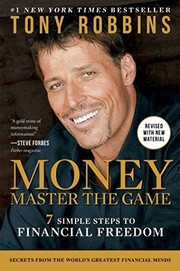
MONEY Master the Game
Interviews with 50 investors, from Dalio to Bogle, turned into money advice.
Interviews with large allocators packaged as retail portfolio advice
Summary
Robbins interviewed around fifty investors including Ray Dalio, Jack Bogle, Warren Buffett, Carl Icahn, David Swensen, Paul Tudor Jones and T. Boone Pickens, and assembled a personal finance book around what they told him. It is over six hundred pages.
The core advice is conventional and correct: fees compound against the investor and should be minimised, index funds are the appropriate default for most people, asset allocation matters more than security selection, tax efficiency is a large part of net returns, and automatic saving matters more than investment skill. He documents mutual fund fee structures in detail, including the difference between stated expense ratios and total costs, and the effect of fees on a lifetime of compounding.
The most cited section is Dalio's description of an all weather allocation, which Robbins presents as a simplified portfolio structured to perform across inflationary and deflationary environments and across growth and contraction. Dalio has publicly noted that the version presented is a simplification of what Bridgewater actually runs. The book also covers annuities at considerable length, and Robbins had commercial relationships in that area, which readers should weigh. It includes substantial motivational material and self-promotion, and the tone is relentless.
The length is disproportionate to the content, which would fit in a hundred pages. The interviews are edited and the subjects are giving general advice rather than describing their actual methods. The fee documentation and the interview material are the parts worth extracting, and Bogle's own books state the same investment case more efficiently.
Key takeaways 8
- Fees compound against an investor and consume a large share of lifetime returns, and the stated expense ratio understates the total cost.
- Index funds are the appropriate default for the large majority of investors, which nearly every interviewee agreed on despite running active strategies themselves.
- Asset allocation determines outcomes more than security selection does, and most investors reverse the attention given to each.
- Tax efficiency is a substantial component of net returns and is almost entirely ignored in how investment products are marketed.
- An allocation designed to perform across inflationary, deflationary, growth and contraction environments differs substantially from a conventional stock and bond split.
- Asymmetric risk and reward, meaning limited downside with substantial upside, was the structure most of the interviewed investors described seeking.
- Automatic saving at a fixed percentage matters more than any investment decision for most people's outcomes.
- The author has commercial relationships in the annuity products discussed at length, which readers should weigh against the recommendations.
Who should read it
Readers who want the interview material and the fee documentation, prepared for a book far longer than its content and with disclosed commercial interests.
Who recommended it 6 · 4 direct
“…books I've recommended, highlighted to death, or forced on friends.”
“Though it has some great information and mindset advice, holy crap it's so damn verbose - 688 pages! - which keeps me from recommending it. But it might be worth skimming to find specific things you're looking for. I had never heard of annuities or private placement life insurance. (That said, I don't want them.) What a weird mix of for-dummies and super-sophisticated advice.”
“it was a great book because what Tony did was to take concepts and make them very clearly conveyed for the average reader”
Similar books 6
Chosen by shared topics, the entries that hold them, and the people who recommended both.
Modern portfolio theory for individual investors, explained without heavy maths.
Recommended by: The Barefoot Investor
How Markowitz, Sharpe, Fama, Black and Scholes built the theory of modern finance.
“But it was in his Capital Ideas, published in 1992, that I first learned of Louis Bachelier’s 1900 dissertation, The Theory of Speculation.” — John C. Bogle
Source: Success In Investment Management: What Can We Learn From Indexing?, page 1
Recommended by: John C. Bogle, Michael Mauboussin
Whether measures of country risk help investors forecast returns.
Markets pay skilled active managers; a survey of the strategies they run.
“Now another outstanding Nordic researcher (and AQR partner), Lasse Heje Pedersen, presents me with the same dilemma: His new book, Efficiently Inefficient (Princeton University Press), is fantastic — almost too good at laying out how successful professional asset managers think and act.” — Clifford Asness
Source: Efficient Inefficiency: The Oxymoron That Explains the Investing World
Recommended by: Clifford Asness, Michael Mauboussin
A six-week programme to automate banking, credit, saving and investing.
“An amazing book about consumer finance and a healthy approach to managing your money. If you are age 18-35, this is a must-read! My notes are scarce, so get the book. Even if over 35, you might find some good tips on lowering your fees on various services, and a good reminder of good savings practices.” — Derek Sivers
Source: Derek Sivers book notes (primary, rated list) · Rating: 7/10
Recommended by: Derek Sivers, Mohnish Pabrai, Nat Eliason and 3 others
Ten people who shaped portfolio theory, profiled from original interviews.