Updates

  1. Person pages list letters, writing, profiles and links as sortable tables with filters, and show each person's companies as links; Fund letters show each letter's description in its own column.
  2. Experts show a checked job title and a short description of each person; 30 more people have photographs.
  3. Every company, fund, university and publication the experts work for has a page listing the people there.
  4. Fund letters show each letter's thesis and filter by it; 225 person pages list the essays, columns and newsletter issues the person wrote.
  5. Person pages list every essay and newsletter issue a person wrote, and their own books as a table in List view.
  6. Recommends shows the five largest kinds of book and the rest under More; browse pictures load sooner.
  7. Podcasts and talks link the original episode, filter by Audio and video or Press, and list each publisher once.
  8. Pages are wider, Recommends has List and Grid, and a filter clicked again turns off.
  9. Book cards sit in a ruled grid with Open Library and Goodreads links and each book's one-line note.
  10. Funds is now Investors; each investor's styles are buttons that filter the table.
  11. Podcasts and talks on a person's page filter by year and publisher and show as a list or a grid of pictures.
  12. Quotes show only people's own words: 472 summaries written by list sites are gone.
  13. Country pages open from Browse again, and every link on the shelf lands on a page.
  14. Subject and person pages show their sections as tabs, and each book appears once on a person's page.
  15. Book cards show the quote, who said it and the source; grids show five cards to a row.
  16. On a phone, a menu holds the sections, search, Updates, Feedback and dark mode.
  17. Feedback takes a screenshot of the page with no browser prompt, opens a screenshot full size when you click it, and clears itself once sent.
  18. Book cards are centred, search names the topic each book sits in, and any text cut short shows whole on hover.
  19. Search groups its results by kind: people, companies, geographies, subjects, topics, books, funds, fund letters and papers.
  20. The Books table lists who recommended each book by name, and the browser tab names the section you are in.
  21. Feedback can take a screenshot of the page, or one you paste or choose, and opens in the corner beside Updates.
  22. Each rail button reopens its section where you left it, and Browse, Table and People show on every book and subject page.
  23. Filters grey out choices that hold nothing instead of hiding them, and Books › People filters by authors or recommenders.
  24. Feedback takes a subject line and up to three screenshots.
  25. Biographies are grouped by the person they are about: 41 new pages, from Abraham Lincoln to Lee Kuan Yew.
  26. Sport splits into 23 sports, and Religion into one topic per faith.
  27. Book lists show as cards: the cover, one recommendation quote and every recommender by name.
  28. Seventeen subjects that had two or three pages under different names now have one page each.
  29. Every page lists its Experts as authors and recommenders, with a link to them on the Experts tab.
  30. Economics, Financial history, Financial panics and Accounting are subjects of their own, with one page per financial crisis.
  31. Book, person and subject pages open inside the app, so the tabs stay in view.
  32. 996 more book covers, and photographs or logos for 227 more people and companies.
  33. Books › Browse shows every subject as cards, and the rail holds Fund letters, Papers, Experts, Books and Funds.
  34. Every topic over 150 books splits into narrower topics, each with a page of its own.

Send feedback

What is it?
Screenshots, up to 3 (optional)
or paste one with Ctrl+V

We use your email only to reply to you.

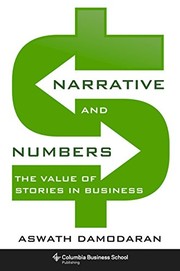
Narrative and Numbers: The Value of Stories

Narrative and Numbers: The Value of Stories in Business

Aswath Damodaran
2017
T4 296 pages · about 4h 56m to read Open Librarygoodreads

Summary

Aswath Damodaran teaches valuation at New York University and argues here that valuation requires both a business narrative and a set of numbers, and that most analysts do only one. Storytellers produce plausible accounts that cannot be tested; number people produce spreadsheets whose assumptions have no justification. His proposal is a discipline for connecting them.

The process he sets out has steps. Develop a narrative about what the business will become. Test it against three standards: is it possible, is it plausible, is it probable. Convert each element of the narrative into a specific input, so that a story about becoming the dominant player in a market becomes an assumption about total market size and market share, and a story about operating leverage becomes an assumption about margins. Value the company from those inputs. Then keep the narrative under review, distinguishing narrative breaks, where the story is wrong, from narrative changes, where circumstances have altered it, from narrative shifts, where the details move within the same story.

He works this through on cases, most extensively Uber in 2014, where his valuation of roughly six billion dollars against a private round at seventeen billion turned on whether Uber was a car service company or a logistics company. He publishes his own errors, including his initial underestimate of Uber's market expansion. The method is genuinely useful and the discipline of converting narrative claims into specific inputs is the transferable part. The book is repetitive, and readers who follow Damodaran's blog will find much of it familiar.

Key takeaways 7

  1. A valuation without a narrative has assumptions that cannot be defended, and a narrative without numbers has claims that cannot be tested.
  2. Every element of a business story must convert into a specific valuation input, or it is not doing analytical work.
  3. Narratives should be tested against whether they are possible, plausible and probable, and most investment stories fail at the third.
  4. Defining the market a company competes in determines most of the valuation, and disagreements about value are usually disagreements about market definition.
  5. A narrative break, where the story turns out to be wrong, requires selling, while a narrative change requires revaluing.
  6. Damodaran argues that uncertainty is not a reason to avoid valuation, since the alternative is pricing without any anchor.
  7. Young companies should be valued from a story about the business they will become rather than from extrapolating current financials.

Who should read it

Investors valuing companies without long operating histories who want a repeatable method for turning a business thesis into defensible numbers.

About Aswath Damodaran

Kerschner Family Chair Professor of Finance, NYU Stern School of Business

His valuation textbooks and freely published datasets are the default reference used across academia, banking and investing.

NYU Stern School of Business

Similar books 6

Chosen by shared topics, the entries that hold them, and the people who recommended both.
Aswath Damodaran · 2007

Risk as a source of value: how firms measure it and take the risks they suit.
Where it sits in the reference 2

Academics
Mental models

Topics

InvestingFinance and Markets