Updates

  1. Person pages list letters, writing, profiles and links as sortable tables with filters, and show each person's companies as links; Fund letters show each letter's description in its own column.
  2. Experts show a checked job title and a short description of each person; 30 more people have photographs.
  3. Every company, fund, university and publication the experts work for has a page listing the people there.
  4. Fund letters show each letter's thesis and filter by it; 225 person pages list the essays, columns and newsletter issues the person wrote.
  5. Person pages list every essay and newsletter issue a person wrote, and their own books as a table in List view.
  6. Recommends shows the five largest kinds of book and the rest under More; browse pictures load sooner.
  7. Podcasts and talks link the original episode, filter by Audio and video or Press, and list each publisher once.
  8. Pages are wider, Recommends has List and Grid, and a filter clicked again turns off.
  9. Book cards sit in a ruled grid with Open Library and Goodreads links and each book's one-line note.
  10. Funds is now Investors; each investor's styles are buttons that filter the table.
  11. Podcasts and talks on a person's page filter by year and publisher and show as a list or a grid of pictures.
  12. Quotes show only people's own words: 472 summaries written by list sites are gone.
  13. Country pages open from Browse again, and every link on the shelf lands on a page.
  14. Subject and person pages show their sections as tabs, and each book appears once on a person's page.
  15. Book cards show the quote, who said it and the source; grids show five cards to a row.
  16. On a phone, a menu holds the sections, search, Updates, Feedback and dark mode.
  17. Feedback takes a screenshot of the page with no browser prompt, opens a screenshot full size when you click it, and clears itself once sent.
  18. Book cards are centred, search names the topic each book sits in, and any text cut short shows whole on hover.
  19. Search groups its results by kind: people, companies, geographies, subjects, topics, books, funds, fund letters and papers.
  20. The Books table lists who recommended each book by name, and the browser tab names the section you are in.
  21. Feedback can take a screenshot of the page, or one you paste or choose, and opens in the corner beside Updates.
  22. Each rail button reopens its section where you left it, and Browse, Table and People show on every book and subject page.
  23. Filters grey out choices that hold nothing instead of hiding them, and Books › People filters by authors or recommenders.
  24. Feedback takes a subject line and up to three screenshots.
  25. Biographies are grouped by the person they are about: 41 new pages, from Abraham Lincoln to Lee Kuan Yew.
  26. Sport splits into 23 sports, and Religion into one topic per faith.
  27. Book lists show as cards: the cover, one recommendation quote and every recommender by name.
  28. Seventeen subjects that had two or three pages under different names now have one page each.
  29. Every page lists its Experts as authors and recommenders, with a link to them on the Experts tab.
  30. Economics, Financial history, Financial panics and Accounting are subjects of their own, with one page per financial crisis.
  31. Book, person and subject pages open inside the app, so the tabs stay in view.
  32. 996 more book covers, and photographs or logos for 227 more people and companies.
  33. Books › Browse shows every subject as cards, and the rail holds Fund letters, Papers, Experts, Books and Funds.
  34. Every topic over 150 books splits into narrower topics, each with a page of its own.

Send feedback

What is it?
Screenshots, up to 3 (optional)
or paste one with Ctrl+V

We use your email only to reply to you.

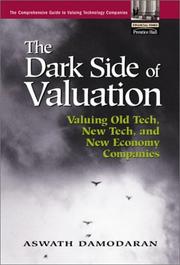
The Dark Side of Valuation

The Dark Side of Valuation

Aswath Damodaran
2001
T4 415 pages · about 6h 55m to read Open Librarygoodreads

Summary

Damodaran addresses valuation in the cases where standard methods break down: young companies with no history, technology companies whose assets are intangible, cyclical and commodity companies whose current earnings are meaningless, financial firms where debt is raw material, companies in emerging markets with unreliable data and unstable currencies, and distressed companies with a real probability of failure.

His approach in each case is to identify why the standard method fails and to adapt it rather than to abandon valuation. For young companies with no history, build the valuation from the total addressable market, an expected market share and a target operating margin, then work backward to the required revenue and reinvestment. For cyclical companies, normalise earnings across a full cycle rather than using current results. For financial firms, value the equity directly rather than the enterprise, since debt is an input to the business. For emerging markets, address country risk explicitly in the discount rate or the cash flows rather than in an arbitrary premium, and be consistent about currency. For distressed companies, value the going concern and then adjust for the probability of failure and the proceeds in that event, which the standard model implicitly assumes away.

His general position is that every valuation contains assumptions and the analyst's job is to make them explicit and defensible rather than to produce a number.

The editions were written after the technology bubble and updated afterwards. The examples date but the methods do not. It is technical and assumes familiarity with standard valuation.

Key takeaways 7

  1. Young companies with no history should be valued from total addressable market, expected share and target margin, working backward to required revenue and reinvestment.
  2. Cyclical and commodity companies must be valued on earnings normalised across a full cycle, since current earnings reflect only the cycle position.
  3. Financial firms require valuing equity directly rather than the enterprise, because debt is their raw material rather than a financing choice.
  4. Distressed companies require valuing the going concern and then adjusting explicitly for the probability of failure, which standard models assume away.
  5. Country risk in emerging market valuations should be addressed explicitly in the cash flows or the discount rate rather than through an arbitrary premium.
  6. Intangible-heavy companies require capitalising research and development, since accounting treats value-creating investment as an expense.
  7. Every valuation contains assumptions, and the analyst's task is to make them explicit and defensible rather than to produce a single number.

Who should read it

Analysts and investors valuing young, cyclical, distressed, financial or emerging market companies where standard methods fail.

About Aswath Damodaran

Kerschner Family Chair Professor of Finance, NYU Stern School of Business

His valuation textbooks and freely published datasets are the default reference used across academia, banking and investing.

NYU Stern School of Business

Who recommended it 1 · 1 direct

Similar books 6

Chosen by shared topics, the entries that hold them, and the people who recommended both.
Aswath Damodaran · 2007

Risk as a source of value: how firms measure it and take the risks they suit.

Where it sits in the reference 2

Academics
Mental models

Topics

InvestingFinance and Markets