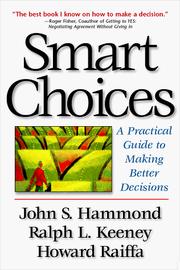
Smart Choices
A step-by-step method for making better decisions in life and work.
Summary
John Hammond, Ralph Keeney and Howard Raiffa, decision scientists from Harvard, MIT and the University of Southern California, teach a simple set of skills for making decisions in life and work. Their examples range from where to live and whether to change careers to which job offer to take, which car to buy and which accountant to hire.
The method combines research with common sense and practical experience. It shows readers how to work out their underlying objectives, create a full set of alternatives, judge the likely consequences of each, make trade-offs between them, and deal with uncertainty. The authors present it as a way to be consistent and confident in decisions, from choosing between mutual funds to deciding where to retire. The sources read here outline the steps but do not detail the tools the authors give for each.
Key takeaways 4
- Good decisions start from a clear statement of objectives.
- Generating a full range of alternatives improves the choice.
- Decisions require explicit trade-offs between competing goals.
- Uncertainty can be handled systematically rather than ignored.
Who should read it
Anyone who wants a practical, step-by-step method for important decisions.
Who recommended it 1 · 1 direct
Similar books 6
Chosen by shared topics, the entries that hold them, and the people who recommended both.
Principles of observation, inference and avoiding error, from the Holmes stories.
Recommended by: Mohnish Pabrai, Patrick O'Shaughnessy and 1 other
The questions and answers of one year's Berkshire Hathaway shareholders meeting.
Recommended by: Mohnish Pabrai
Complex problems yield to trial and error, not expert plans, and how to run it.
“There is a book I recently ran into by Tim Hartford called Adapt. That’s another kind of fun read; I thought that was pretty good.” — Mohnish Pabrai
Source: Pabrai Investment Funds Annual Meeting Transcript 2011, page 48
Recommended by: Mohnish Pabrai, Patrick O'Shaughnessy
How people learned to measure risk, from early probability to portfolio theory.
“(Risk is the subject of Peter Bernstein’s wonderful new book, Against the Gods: The Remarkable Story of Risk.)” — Bill Miller
Source: 1996 Q3 Market Commentary
Recommended by: Bill Miller, Charles de Vaulx, Howard Marks and 9 others
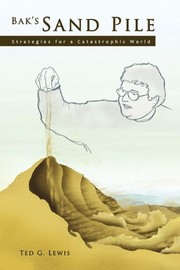
The pattern behind catastrophes from blackouts to oil spills, and how to plan.
Recommended by: Mohnish Pabrai
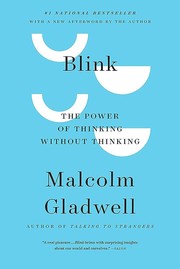
How snap judgments work, when to trust them and when they mislead.
“Malcolm Gladwell, Blink: The Power of Thinking Without Thinking (New York: Little, Brown and Company, 2005)” — Michael Mauboussin
Source: Are You an Expert? Experts and Markets, page 9
Recommended by: Michael Mauboussin, Mohnish Pabrai and 2 others
Where it sits in the reference 1
Topics 1
As an Amazon Associate I earn from qualifying purchases.