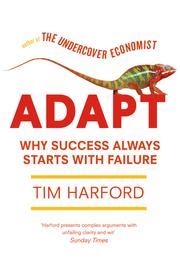
Adapt: Why Success Always Starts with Failure
Complex problems yield to trial and error, not expert plans, and how to run it.
Summary
Harford argues that complex problems are not solved by expert planning but by a process of variation and selection, and that the requirements for that process are specific: generate many attempts, keep each one survivable, and be able to tell success from failure quickly enough to act.
The cases run wide. He examines the United States military's adaptation in Iraq, where field commanders including H.R. McMaster developed counterinsurgency methods that the command structure initially rejected; the Piper Alpha oil rig disaster and the Deepwater Horizon blowout as failures of decoupling in tightly coupled systems; randomised controlled trials in development aid; the Skunk Works and the Spitfire as products of protected deviant projects; the 2008 banking failure as a system where losses were not survivable; and corporate innovation portfolios. He draws on Perrow's normal accident theory, on Tetlock's expert prediction work, and on evolutionary and complexity research.
The practical prescription is what makes it useful: run experiments that are genuinely varied rather than incremental, ensure failure is survivable so the organisation can keep experimenting, and build feedback that a manager cannot ignore or explain away. Harford is honest that the third condition is the hardest, because people and organisations are structured to avoid recognising failure. The weaknesses are that the argument is assembled from case studies selected to fit, that some of the psychology cited has weakened since 2011, and that the prescriptions are easier to state than to implement in an organisation whose incentives punish visible failure.
Key takeaways 7
- Complex problems are solved by variation and selection rather than by expert planning, because no planner has the information the process generates.
- Successful adaptation requires three conditions together: try many genuinely different things, keep each attempt survivable, and know quickly which ones failed.
- Organisations fail at the third condition because recognising failure carries a career cost for the person who must recognise it.
- Tightly coupled systems fail catastrophically because a fault propagates faster than operators can respond, so decoupling matters more than adding safety procedures.
- Innovation requires protected space in which deviant projects can proceed without the approval of the people whose positions they threaten.
- Randomised trials in policy and business are valuable precisely because they can show that a favoured intervention does not work.
- Financial systems become dangerous when losses are not survivable, since that removes the ability to experiment and forces the suppression of bad news.
Who should read it
Operators and investors designing experimentation processes who need the conditions under which trial and error actually produces learning.
Who recommended it 2 · 2 direct
“There is a book I recently ran into by Tim Hartford called Adapt. That’s another kind of fun read; I thought that was pretty good.”
Similar books 6
Chosen by shared topics, the entries that hold them, and the people who recommended both.
The biases that distort managers' decisions, with exercises that show them.
“Max Bazerman, Judgment in Managerial Decision Making, 4th ed. (New York: John Wiley & Son, 1998), 6-17” — Michael Mauboussin
Source: The Janitor’s Dream: Why Listening to Individuals Can be Hazardous to Your Wealth, page 3
Recommended by: Michael Mauboussin, Mohnish Pabrai and 1 other

How the wish for agreement in close groups led to fiascos like the Bay of Pigs.
“Irving Janis, Groupthink: Psychological Studies of Policy Decisions and Fiascoes, 2nd ed. (Boston, MA: Houghton Mifflin, 1982)” — Michael Mauboussin
Source: Building an Effective Team: How to Manage a Team to Make Good Decisions, page 17
Recommended by: Adam Weiss, Barton Biggs, Michael Mauboussin
Game theory applied to business, which is cooperative and competitive at once.
“Adam M. Brandenburger and Barry J. Nalebuff, Co-opetition (New York: Currency Doubleday, 1996)” — Michael Mauboussin
Source: The Ecosystem Edge, page 10
Recommended by: Michael Mauboussin, Mohnish Pabrai
Why admired companies and their chief executives fail, and the lessons.
Recommended by: Mohnish Pabrai
What 16,000 projects show about why big ones overrun, and how to plan them.
“Bent Flyvbjerg and Dan Gardner, How Big Things Get Done: The Surprising Factors That Determine the Fate of Every Project, from Home Renovations to Space Exploration and Everything In Between (New York: Crown Currency, 2023)” — Michael Mauboussin
Source: Pattern Recognition: Opportunities and Limits, page 14
Recommended by: Michael Mauboussin
Why a few simple rules help people and firms decide well in a complex world.
“Not a book that gives you simple rules. Instead it's on the meta-topic of simple rules. Gives examples from medicine, crime, gambling, investing, etc.” — Derek Sivers
Source: Derek Sivers book notes (primary, rated list) · Rating: 2/10
Recommended by: Derek Sivers, Nat Eliason