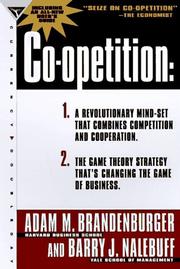
Co-opetition
Game theory applied to business, which is cooperative and competitive at once.
Summary
Brandenburger and Nalebuff apply game theory to business strategy and argue that business is simultaneously cooperative and competitive, and that most strategic thinking misses the cooperative half. Their central tool is the value net, which places the firm at the centre with customers, suppliers, competitors and a fourth category they name: complementors, meaning players whose product makes yours more valuable to the customer.
The complementor concept is the book's main contribution. They argue that firms systematically manage relationships with customers, suppliers and competitors while ignoring complementors, and that the complementor relationship is frequently where the most value can be created or lost. They give worked examples across hardware and software, cars and finance, and airlines and hotels.
The analytical method is what they call added value: a player's added value is the total value created by the game with them in it minus the total created without them, and no player can capture more than their added value. This gives a rigorous way to assess bargaining position and to ask how to raise your own added value or lower a rival's. They set out five levers, being players, added values, rules, tactics and scope, and argue that changing the game is usually more profitable than playing the existing game better.
The book is practical and its framework is directly usable. Its weakness is that added value is easier to define than to measure, and the examples are chosen after the fact. Game theory applied to business remains better at explaining outcomes than at predicting them.
Key takeaways 7
- Business is simultaneously cooperative and competitive, and most strategic analysis attends only to the competitive part.
- Complementors, meaning players whose product raises the value of yours, are a distinct category from suppliers and competitors and are usually unmanaged.
- A player cannot capture more value than their added value, which is the difference between the value created with them in the game and without them.
- Raising your own added value or reducing a competitor's is the fundamental strategic move, and both are achievable without any change in product quality.
- Changing the game, by altering the players, rules or scope, produces more value than playing the existing game better.
- Paying a supplier to enter a market where you have only one supplier raises your added value by creating competition you control.
- The same firm can be a competitor in one relationship and a complementor in another, and the correct treatment differs entirely between the two.
Who should read it
Founders and executives who want a structured way to identify complementors, assess bargaining position and change the terms of competition.
Who recommended it 2 · 2 direct
“Adam M. Brandenburger and Barry J. Nalebuff, Co-opetition (New York: Currency Doubleday, 1996)”
Similar books 6
Chosen by shared topics, the entries that hold them, and the people who recommended both.
Game theory without maths: look forward, reason back, and make threats credible.
“Avinash K. Dixit and Barry J. Nalebuff, Thinking Strategically (New York: W. W. Norton & Co., 1991)” — Michael Mauboussin
Source: Measuring the Moat: Assessing the Magnitude and Sustainability of Value Creation, page 47
Recommended by: Jim Collins, Michael Mauboussin
Why most so-called strategies are not, and the three-part kernel real ones need.
“Rumelt, Richard P., Good Strategy Bad Strategy: The Difference and Why It Matters (New York: Crown Business, 2011)” — Michael Mauboussin
Source: Measuring the Moat: Assessing the Magnitude and Sustainability of Value Creation, page 65
Recommended by: Michael Mauboussin, Ann Handley and 3 others

The biases that distort managers' decisions, with exercises that show them.
“Max Bazerman, Judgment in Managerial Decision Making, 4th ed. (New York: John Wiley & Son, 1998), 6-17” — Michael Mauboussin
Source: The Janitor’s Dream: Why Listening to Individuals Can be Hazardous to Your Wealth, page 3
Recommended by: Michael Mauboussin, Mohnish Pabrai and 1 other
Complex problems yield to trial and error, not expert plans, and how to run it.
“There is a book I recently ran into by Tim Hartford called Adapt. That’s another kind of fun read; I thought that was pretty good.” — Mohnish Pabrai
Source: Pabrai Investment Funds Annual Meeting Transcript 2011, page 48
Recommended by: Mohnish Pabrai, Patrick O'Shaughnessy
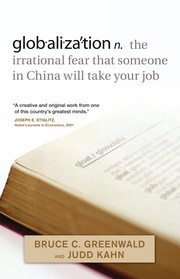
Why globalisation matters less than the shift from manufacturing to services.
“A terrific resource for this argument is Bruce C. Greenwald and Judd Kahn, Globalization: The Irrational Fear That Someone in China Will Take Your Job (Hoboken, NJ: John Wiley & Sons, 2008)” — Michael Mauboussin
Source: Blaming the Rat: Incentives, Motivation, and How They Interact, page 13
Recommended by: Michael Mauboussin

What 16,000 projects show about why big ones overrun, and how to plan them.
“Bent Flyvbjerg and Dan Gardner, How Big Things Get Done: The Surprising Factors That Determine the Fate of Every Project, from Home Renovations to Space Exploration and Everything In Between (New York: Crown Currency, 2023)” — Michael Mauboussin
Source: Pattern Recognition: Opportunities and Limits, page 14
Recommended by: Michael Mauboussin