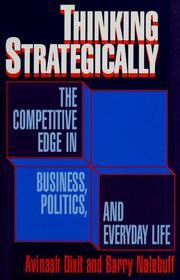
Thinking Strategically
Game theory without maths: look forward, reason back, and make threats credible.
Summary
Dixit and Nalebuff present game theory for readers without mathematics, using business, political, sporting and everyday examples. It was the book that made strategic reasoning accessible outside economics departments.
The content covers the core concepts and how to apply them. Sequential games are solved by looking forward and reasoning backward, which they illustrate with entry decisions and negotiations. Simultaneous games introduce dominant strategies, equilibrium and the prisoner's dilemma, with the mechanisms that sustain cooperation in repeated play, including tit-for-tat and the effect of a known endpoint. Commitment and credibility get extended treatment: they show why a threat or promise only works when the party making it would actually carry it out, and they catalogue the devices that make commitments credible, including burning bridges, delegating to an agent with different incentives, contracts with penalties, and building a reputation. Mixed strategies explain why unpredictability is optimal in some competitive situations. They also cover brinkmanship as the deliberate creation of risk, auction and bidding behaviour, voting rules and incentive design.
The book is practical and the examples are chosen well. It is an introduction and does not equip a reader to model a real situation formally. Some of the applied cases, particularly on Cold War strategy and on specific business situations, are of their period, and the later Art of Strategy is an updated version of the same material. Game theory's predictive record in applied settings is weaker than the book's confidence implies, which readers should hold in mind.
Key takeaways 7
- Sequential decisions should be solved by looking forward to the final outcome and reasoning backward to the current choice.
- A threat or promise changes behaviour only if the other party believes you would carry it out, so credibility is the entire content of a commitment.
- Reducing your own options can improve your position, because removing the possibility of backing down makes a commitment believable.
- Cooperation in a repeated interaction is sustained by the expectation of future encounters, and a known final round unravels it from the end backward.
- Unpredictability is the optimal strategy in competitive situations where any pattern can be exploited, which is why mixed strategies exist.
- Brinkmanship works by creating a risk of an outcome bad for both parties that neither fully controls, rather than by threatening a deliberate action.
- The party who moves first gains advantage in some games and loses it in others, and identifying which case applies determines whether to commit early or wait.
Who should read it
Operators and negotiators who want practical strategic reasoning about commitment, credibility and competitive response without formal mathematics.
Who recommended it 2 · 2 direct
“Avinash K. Dixit and Barry J. Nalebuff, Thinking Strategically (New York: W. W. Norton & Co., 1991)”
Similar books 6
Chosen by shared topics, the entries that hold them, and the people who recommended both.
Game theory without maths, with new examples: commitment, signals, bargaining.
“for business, see Avinash K. Dixit and Barry J. Nalebuff, The Art of Strategy (New York: W.W. Norton & Company, 2008)” — Michael Mauboussin
Source: The Colonel Blotto Game: Transitivity and How to Win When You’re an Underdog, page 8
Recommended by: Michael Mauboussin, Marc Andreessen
Game theory applied to business, which is cooperative and competitive at once.
“Adam M. Brandenburger and Barry J. Nalebuff, Co-opetition (New York: Currency Doubleday, 1996)” — Michael Mauboussin
Source: The Ecosystem Edge, page 10
Recommended by: Michael Mauboussin, Mohnish Pabrai
The founding of game theory: expected utility and strategy among interacting players.
“John von Neumann and Oskar Morgenstern, Theory of Games and Economic Behavior (Princeton, NJ: Princeton University Press, 1944)” — Michael Mauboussin
Source: Competitive Advantage Period: The Neglected Value Driver
Recommended by: Michael Mauboussin
Von Neumann, game theory and the prisoner's dilemma in nuclear strategy.
“For international relations, see William Poundstone, Prisoner’s Dilemma (New York: Doubleday, 1992)” — Michael Mauboussin
Source: The Colonel Blotto Game: Transitivity and How to Win When You’re an Underdog, page 8
Recommended by: Michael Mauboussin
Why most so-called strategies are not, and the three-part kernel real ones need.
“Rumelt, Richard P., Good Strategy Bad Strategy: The Difference and Why It Matters (New York: Crown Business, 2011)” — Michael Mauboussin
Source: Measuring the Moat: Assessing the Magnitude and Sustainability of Value Creation, page 65
Recommended by: Michael Mauboussin, Ann Handley and 3 others
Conflict as bargaining: commitment, credible threats and focal points.
Recommended by: Naval Ravikant