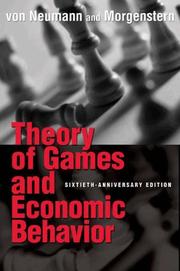
Theory of Games and Economic Behavior
The founding of game theory: expected utility and strategy among interacting players.
Summary
John von Neumann and Oskar Morgenstern published this in 1944 and it created game theory as a field. Its ambition was to supply economics with a mathematical foundation appropriate to situations where outcomes depend on the interacting decisions of multiple parties.
The book's first substantial contribution is the axiomatic derivation of expected utility. Von Neumann and Morgenstern set out axioms describing consistent preferences over lotteries and show that anyone satisfying them behaves as if maximising the expected value of a utility function. This became the foundation of decision theory under uncertainty and of every subsequent model in financial economics.
The game theory itself covers two-person zero-sum games, where the minimax theorem von Neumann had proved in 1928 establishes that a solution in mixed strategies always exists, and then n-person and cooperative games, where the authors develop coalition analysis and the concept of a stable set. The cooperative theory occupies most of the book and has proved less influential than the two-person material and than the non-cooperative equilibrium concept that John Nash introduced six years later. The book is long, difficult and written in a mathematical style that few economists could read at the time. Its influence came through others: the expected utility axioms and the minimax theorem entered economics immediately, while game theory itself took several decades to become central.
Key takeaways 7
- Von Neumann and Morgenstern derived expected utility from axioms about consistent preferences over lotteries, which founded decision theory under uncertainty.
- Anyone whose preferences satisfy the stated axioms behaves as if maximising the expected value of a utility function.
- The minimax theorem establishes that two-person zero-sum games always have a solution in mixed strategies.
- Randomising between strategies can be optimal, which had no place in economic reasoning before this.
- Most of the book concerns cooperative games and coalition formation, which proved less influential than the two-person material.
- Economic situations in which outcomes depend on interacting decisions require different mathematics from optimisation against nature.
- Nash's non-cooperative equilibrium concept, published six years later, became more central than the cooperative theory developed here.
Who should read it
Readers who want the founding text of game theory and of expected utility, understanding that its influence came through work that followed it.
Who recommended it 1 · 1 direct
“John von Neumann and Oskar Morgenstern, Theory of Games and Economic Behavior (Princeton, NJ: Princeton University Press, 1944)”
Similar books 6
Chosen by shared topics, the entries that hold them, and the people who recommended both.
Game theory without maths, with new examples: commitment, signals, bargaining.
“for business, see Avinash K. Dixit and Barry J. Nalebuff, The Art of Strategy (New York: W.W. Norton & Company, 2008)” — Michael Mauboussin
Source: The Colonel Blotto Game: Transitivity and How to Win When You’re an Underdog, page 8
Recommended by: Michael Mauboussin, Marc Andreessen
Game theory without maths: look forward, reason back, and make threats credible.
“Avinash K. Dixit and Barry J. Nalebuff, Thinking Strategically (New York: W. W. Norton & Co., 1991)” — Michael Mauboussin
Source: Measuring the Moat: Assessing the Magnitude and Sustainability of Value Creation, page 47
Recommended by: Jim Collins, Michael Mauboussin

Von Neumann, game theory and the prisoner's dilemma in nuclear strategy.
“For international relations, see William Poundstone, Prisoner’s Dilemma (New York: Doubleday, 1992)” — Michael Mauboussin
Source: The Colonel Blotto Game: Transitivity and How to Win When You’re an Underdog, page 8
Recommended by: Michael Mauboussin
Conflict as bargaining: commitment, credible threats and focal points.
Recommended by: Naval Ravikant
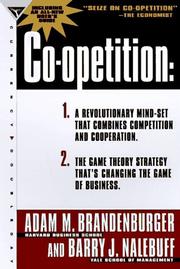
Game theory applied to business, which is cooperative and competitive at once.
“Adam M. Brandenburger and Barry J. Nalebuff, Co-opetition (New York: Currency Doubleday, 1996)” — Michael Mauboussin
Source: The Ecosystem Edge, page 10
Recommended by: Michael Mauboussin, Mohnish Pabrai
When standard decision theory applies under uncertainty, and when it does not.
Recommended by: Nassim Nicholas Taleb