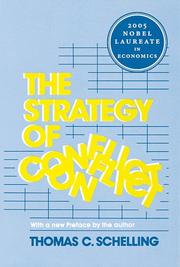
The Strategy of Conflict
Conflict as bargaining: commitment, credible threats and focal points.
Commitment, threats and bargaining; the founding text of strategic conflict
Summary
Schelling reframed conflict as bargaining rather than as a contest to be won, and this book is the founding work of strategic thinking about negotiation, deterrence and coordination. He argued that most conflicts are mixed-motive, meaning the parties have both common and opposing interests, and that pure conflict and pure cooperation are limiting cases rather than the norm.
His central insight concerns commitment. Schelling showed that the ability to constrain your own options can be a source of bargaining power: a negotiator who can credibly demonstrate that they cannot concede will win the concession. He works through the mechanisms, including publicly staking reputation, delegating authority to an agent who cannot compromise, entering into binding contracts with third parties, and deliberately destroying communication channels. The counterintuitive conclusion is that weakness, ignorance and irrationality can each be advantages when they are demonstrable.
His second contribution is the focal point, the observation that in coordination problems without communication people converge on solutions that are salient for reasons outside the game's payoff structure. He demonstrated this experimentally with questions about where to meet a stranger in New York.
His third is the theory of deterrence, including the distinction between deterrence and compellence, the requirements for a credible second strike, the stability of mutual vulnerability, and the danger of a first-strike advantage, which shaped nuclear strategy directly.
The book is written with precision and almost no mathematics. Its influence on both nuclear strategy and negotiation practice is enormous, and the analysis has not been superseded.
Key takeaways 7
- Constraining your own options can be a source of bargaining power, because a party who demonstrably cannot concede will receive the concession.
- Most conflicts are mixed-motive, with common and opposing interests present simultaneously, so treating them as pure contests produces bad strategy.
- A threat works only if carrying it out would be rational at the moment it is called, which is why most threats fail and why commitment devices exist.
- In coordination problems without communication, people converge on solutions that are salient for reasons outside the payoff structure.
- Deterrence and compellence are different problems, since preventing an action is easier than forcing one because inaction requires no visible submission.
- Mutual vulnerability is stabilising while a first-strike advantage is destabilising, because the latter creates a reason to act before the other party does.
- Deliberately introducing a risk that neither party fully controls can be more effective than a threat either party could choose to withdraw.
Who should read it
Negotiators, executives and strategists who want the foundational analysis of commitment, credibility and coordination.
Who recommended it 1 · 1 direct
Similar books 6
Chosen by shared topics, the entries that hold them, and the people who recommended both.
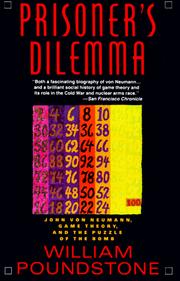
Von Neumann, game theory and the prisoner's dilemma in nuclear strategy.
“For international relations, see William Poundstone, Prisoner’s Dilemma (New York: Doubleday, 1992)” — Michael Mauboussin
Source: The Colonel Blotto Game: Transitivity and How to Win When You’re an Underdog, page 8
Recommended by: Michael Mauboussin
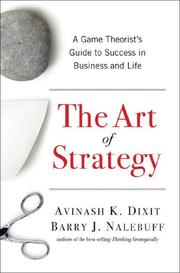
Game theory without maths, with new examples: commitment, signals, bargaining.
“for business, see Avinash K. Dixit and Barry J. Nalebuff, The Art of Strategy (New York: W.W. Norton & Company, 2008)” — Michael Mauboussin
Source: The Colonel Blotto Game: Transitivity and How to Win When You’re an Underdog, page 8
Recommended by: Michael Mauboussin, Marc Andreessen
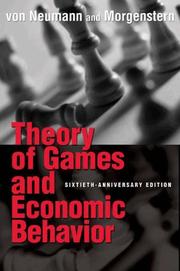
The founding of game theory: expected utility and strategy among interacting players.
“John von Neumann and Oskar Morgenstern, Theory of Games and Economic Behavior (Princeton, NJ: Princeton University Press, 1944)” — Michael Mauboussin
Source: Competitive Advantage Period: The Neglected Value Driver
Recommended by: Michael Mauboussin
Game theory without maths: look forward, reason back, and make threats credible.
“Avinash K. Dixit and Barry J. Nalebuff, Thinking Strategically (New York: W. W. Norton & Co., 1991)” — Michael Mauboussin
Source: Measuring the Moat: Assessing the Magnitude and Sustainability of Value Creation, page 47
Recommended by: Jim Collins, Michael Mauboussin
When standard decision theory applies under uncertainty, and when it does not.
Recommended by: Nassim Nicholas Taleb
A primer on the theory of games of strategy, written for non-specialists.
Recommended by: Naval Ravikant