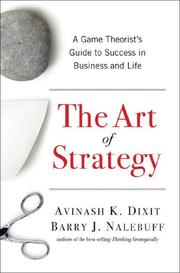
The Art of Strategy
Game theory without maths, with new examples: commitment, signals, bargaining.
Summary
This is Dixit and Nalebuff's updated and reorganised version of Thinking Strategically, covering the same material with new examples and additional topics. It presents game theory for readers without mathematics.
The content covers backward induction in sequential games, dominant strategies and equilibrium in simultaneous games, the prisoner's dilemma and the mechanisms that sustain cooperation, commitment and credibility with the full catalogue of devices that make a threat or promise believable, mixed strategies and the value of unpredictability, brinkmanship, and information problems including signalling and screening.
The additions relative to the 1991 book include more material on auctions, on incentive design and mechanism design, on voting rules and their manipulation, and on bargaining. The examples are updated with material from business negotiations, sports, television game shows and political contests. The chapter on how to use a game show format to illustrate strategic reasoning is genuinely instructive.
The book works as either a first introduction or as a refresher, and it is more accessible than most formal treatments. Its limitations are the same as its predecessor's: it teaches recognition of strategic structures rather than the ability to model a real situation, and the confidence with which game theoretic reasoning is applied to business and political situations exceeds what its predictive record supports. Readers who have read Thinking Strategically will find substantial overlap and should treat this as a replacement rather than a companion.
Key takeaways 7
- Sequential decisions should be solved by reasoning backward from the final outcome to the present choice.
- A threat or promise only changes the other party's behaviour if they believe you would carry it out, which makes credibility the entire content of a commitment.
- Deliberately removing your own options can strengthen your position, because a party that cannot back down receives the concession.
- Unpredictability is optimal in competitive situations where any pattern would be exploited, which is what mixed strategies formalise.
- Cooperation in repeated interactions is sustained by the expectation of future encounters, and a known final round destroys it from the end backward.
- Signalling works only when the signal is more costly for those who lack the quality being signalled, which is why cheap claims convey nothing.
- Auction and voting rules determine outcomes as much as the participants' preferences do, which makes rule design a strategic act in itself.
Who should read it
Operators and negotiators wanting practical strategic reasoning without mathematics, as a replacement for rather than companion to Thinking Strategically.
Who recommended it 2 · 1 direct
“for business, see Avinash K. Dixit and Barry J. Nalebuff, The Art of Strategy (New York: W.W. Norton & Company, 2008)”
Similar books 6
Chosen by shared topics, the entries that hold them, and the people who recommended both.
Game theory without maths: look forward, reason back, and make threats credible.
“Avinash K. Dixit and Barry J. Nalebuff, Thinking Strategically (New York: W. W. Norton & Co., 1991)” — Michael Mauboussin
Source: Measuring the Moat: Assessing the Magnitude and Sustainability of Value Creation, page 47
Recommended by: Jim Collins, Michael Mauboussin
The founding of game theory: expected utility and strategy among interacting players.
“John von Neumann and Oskar Morgenstern, Theory of Games and Economic Behavior (Princeton, NJ: Princeton University Press, 1944)” — Michael Mauboussin
Source: Competitive Advantage Period: The Neglected Value Driver
Recommended by: Michael Mauboussin
Von Neumann, game theory and the prisoner's dilemma in nuclear strategy.
“For international relations, see William Poundstone, Prisoner’s Dilemma (New York: Doubleday, 1992)” — Michael Mauboussin
Source: The Colonel Blotto Game: Transitivity and How to Win When You’re an Underdog, page 8
Recommended by: Michael Mauboussin
Conflict as bargaining: commitment, credible threats and focal points.
Recommended by: Naval Ravikant
Game theory applied to business, which is cooperative and competitive at once.
“Adam M. Brandenburger and Barry J. Nalebuff, Co-opetition (New York: Currency Doubleday, 1996)” — Michael Mauboussin
Source: The Ecosystem Edge, page 10
Recommended by: Michael Mauboussin, Mohnish Pabrai
Computer tournaments of the prisoner's dilemma show why tit-for-tat wins.
“That clever but unsatisfying explanation eventually led me to the book and article that I'm recommending this year - The Evolution of Cooperation by Robert Axelrod, and a related journal article1 (jointly, "EoC").” — Mark Leonard
Source: Constellation Software Inc. 2014 President's Letter, page 5
Recommended by: Mark Leonard, Michael Mauboussin and 2 others