Rational Decisions
When standard decision theory applies under uncertainty, and when it does not.
Binmore on when Bayesian decision theory applies and when it does not
Summary
Binmore, a game theorist, examines the foundations of rational decision theory and argues that its standard apparatus is being applied far outside the conditions under which it is valid. His organising distinction, borrowed from Savage, is between a small world, where all states, consequences and probabilities can be specified in advance, and a large world, where they cannot.
His argument is that Bayesian decision theory is correct and unassailable in small worlds and has no justification in large ones. Savage himself said applying his theory to a large world would be utterly ridiculous, and Binmore takes this seriously. He works through the standard justifications for Bayesian priors, including the principle of insufficient reason and various axiomatic derivations, and argues each fails when the state space itself is not known. He also addresses the Ellsberg paradox, ambiguity aversion, and the question of what a probability means when there is no frequency to ground it.
He is critical of both the Bayesian orthodoxy in economics, for extending the theory beyond its warrant, and of some behavioural economics, for treating deviations from a theory that does not apply as evidence of irrationality.
The book is technical and requires mathematics. It offers a diagnosis more than a replacement, since Binmore's positive proposal for large worlds is tentative. For investors the value is precise: it tells you when probability-based reasoning is well founded and when assigning a number is a gesture rather than an analysis, which is the question that most quantitative risk work avoids.
Key takeaways 7
- Bayesian decision theory is valid in small worlds where all states and consequences can be specified in advance, and has no justification outside them.
- Savage, who constructed the theory, regarded applying it to large worlds as indefensible, and economics has ignored that restriction.
- Assigning a subjective probability to an event whose state space is not known is a gesture rather than an analysis.
- Ambiguity aversion is a reasonable response to situations where probabilities are not available, not a departure from rationality.
- Behavioural economics sometimes treats deviations from a theory that does not apply as evidence of irrationality, which misdiagnoses the problem.
- The principle of insufficient reason cannot ground priors, because the answer depends on how the possibilities are described rather than on anything about the world.
- Rationality in a large world consists in reasoning carefully about a situation you cannot fully specify rather than in maximising an expected utility you cannot compute.
Who should read it
Analytically minded investors and risk practitioners who need to know when probability-based decision analysis is well founded and when it is not.
Who recommended it 1
Similar books 6
Chosen by shared topics, the entries that hold them, and the people who recommended both.
Game theory without maths, with new examples: commitment, signals, bargaining.
“for business, see Avinash K. Dixit and Barry J. Nalebuff, The Art of Strategy (New York: W.W. Norton & Company, 2008)” — Michael Mauboussin
Source: The Colonel Blotto Game: Transitivity and How to Win When You’re an Underdog, page 8
Recommended by: Michael Mauboussin, Marc Andreessen
The founding of game theory: expected utility and strategy among interacting players.
“John von Neumann and Oskar Morgenstern, Theory of Games and Economic Behavior (Princeton, NJ: Princeton University Press, 1944)” — Michael Mauboussin
Source: Competitive Advantage Period: The Neglected Value Driver
Recommended by: Michael Mauboussin
Game theory without maths: look forward, reason back, and make threats credible.
“Avinash K. Dixit and Barry J. Nalebuff, Thinking Strategically (New York: W. W. Norton & Co., 1991)” — Michael Mauboussin
Source: Measuring the Moat: Assessing the Magnitude and Sustainability of Value Creation, page 47
Recommended by: Jim Collins, Michael Mauboussin
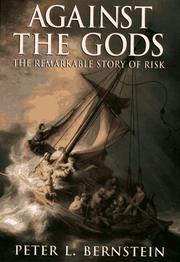
How people learned to measure risk, from early probability to portfolio theory.
“(Risk is the subject of Peter Bernstein’s wonderful new book, Against the Gods: The Remarkable Story of Risk.)” — Bill Miller
Source: 1996 Q3 Market Commentary
Recommended by: Bill Miller, Charles de Vaulx, Howard Marks and 9 others
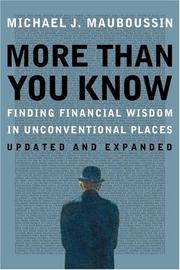
Essays on investing philosophy, psychology, competition and science.
“My colleague Michael Mauboussin applied some of Gould’s analysis to investing in Chapter 6 of his book More Than You Know.” — Bill Miller
Source: 2006 Q4 Market Commentary
Recommended by: Bill Miller and 1 other
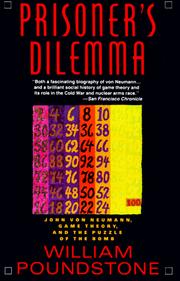
Von Neumann, game theory and the prisoner's dilemma in nuclear strategy.
“For international relations, see William Poundstone, Prisoner’s Dilemma (New York: Doubleday, 1992)” — Michael Mauboussin
Source: The Colonel Blotto Game: Transitivity and How to Win When You’re an Underdog, page 8
Recommended by: Michael Mauboussin
Where it sits in the reference 3
Topics 2
As an Amazon Associate I earn from qualifying purchases.