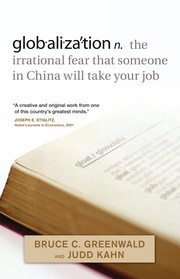
Globalization: n. the irrational fear that someone in China will take your job
Why globalisation matters less than the shift from manufacturing to services.
Summary
Greenwald and Kahn argue that globalisation is far less economically significant than both its advocates and its opponents claim, and that the important economic transformation of the period is the shift from manufacturing to services, which is inherently local.
Their evidence is the composition of advanced economies. Services account for the large majority of output and employment, most services must be produced where they are consumed, and international trade is concentrated in goods, which are a shrinking share of the economy. They document that trade as a share of GDP, correctly measured against the tradeable portion of the economy, has grown far less than headline figures suggest, and that most economic activity in developed countries is untouched by international competition.
They then apply Greenwald's competitive strategy framework, arguing that competitive advantage is almost always local, deriving from customer captivity, local economies of scale relative to a defined market, and regulatory position, and that global scale is rarely a source of advantage because the fixed costs it spreads are usually small relative to the coordination costs it adds. From this they argue that most global expansion strategies destroy value and that firms should dominate defined local markets instead.
The strategic argument is the stronger half and is consistent with Greenwald's other work. The macroeconomic argument understates the labour market effects of import competition, which subsequent research on the China shock documented as larger and more geographically concentrated than the book allows. The 2008 publication also predates the services trade growth of the following decade.
Key takeaways 7
- Services account for most output and employment in advanced economies and must largely be produced where they are consumed, which limits globalisation's reach.
- Trade measured against the tradeable portion of the economy has grown far less than headline trade-to-GDP figures suggest.
- Competitive advantage is almost always local, deriving from customer captivity and economies of scale relative to a defined market rather than from global size.
- Global scale rarely creates advantage because the fixed costs it spreads are small relative to the coordination costs it adds.
- Most international expansion by firms destroys value, because the firm enters markets where local competitors hold the advantages it holds at home.
- Dominating a defined local market produces higher returns than participating in a global one, since local dominance is defensible and global participation is not.
- The significant economic transformation of the period is the shift from manufacturing to services, not the increase in trade.
Who should read it
Operators and investors assessing international expansion strategies who want the case that competitive advantage is local.
About Bruce Greenwald
Robert Heilbrunn Professor Emeritus of Finance and Asset Management, Columbia Business School; former director of the Heilbrunn Center for Graham and Dodd Investing
Value Investing: From Graham to Buffett and Beyond is the canonical modern restatement of the Columbia value framework, and Competition Demystified is its standard companion on barriers to entry.
Who recommended it 1 · 1 direct
“A terrific resource for this argument is Bruce C. Greenwald and Judd Kahn, Globalization: The Irrational Fear That Someone in China Will Take Your Job (Hoboken, NJ: John Wiley & Sons, 2008)”
Similar books 6
Chosen by shared topics, the entries that hold them, and the people who recommended both.
Why barriers to entry are the one force that matters in business strategy.
“Bruce Greenwald and Judd Kahn, Competition Demystified: A Radically Simplified Approach to Business Strategy (New York: Portfolio, 2005), 52-76” — Michael Mauboussin
Source: New Business Boom and Bust: How Capitalism Experiments, page 9
Recommended by: Li Lu, Michael Mauboussin, Mohnish Pabrai
Why most media companies destroy shareholder value: few have barriers to entry.
Recommended by: Keith Rabois

Game theory applied to business, which is cooperative and competitive at once.
“Adam M. Brandenburger and Barry J. Nalebuff, Co-opetition (New York: Currency Doubleday, 1996)” — Michael Mauboussin
Source: The Ecosystem Edge, page 10
Recommended by: Michael Mauboussin, Mohnish Pabrai
Why certain countries become home to world-leading firms in certain industries.
“Porter, Michael E., The Competitive Advantage of Nations (New York: Free Press, 1990)” — Michael Mauboussin
Source: Public to Private Equity in the United States: A Long-Term Look, page 67
Recommended by: Michael Mauboussin

The value chain: how to find where a firm's cost or differentiation advantage lies.
“For example, I read Competitive Strategy and Competitive Advantage by Michael Porter.” — Michael Mauboussin
Source: Thirty Years: Reflections on the Ten Attributes of Great Investors, page 3
Recommended by: Michael Mauboussin, Li Lu
The five forces model for analysing an industry and a firm's place in it.
“For example, I read Competitive Strategy and Competitive Advantage by Michael Porter.” — Michael Mauboussin
Source: Thirty Years: Reflections on the Ten Attributes of Great Investors, page 3
Recommended by: Jim Collins, Michael Mauboussin and 3 others