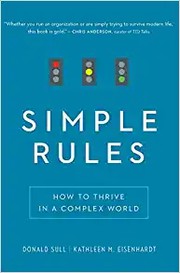
Simple Rules
Why a few simple rules help people and firms decide well in a complex world.
Summary
Donald Sull, a senior lecturer at MIT's Sloan School of Management, and Kathleen Eisenhardt, a professor at Stanford's School of Engineering, argue that a few simple rules let people master complex problems. The 2015 book, subtitled How to Thrive in a Complex World, starts from everyday complexity, too much email, too many remote controls and dense regulations from phone contracts to health plans, and holds that complexity is not destiny.
The authors explain what simple rules are, where they come from and why they work, and set out the six kinds of rule that matter. Their examples cover artists seeking creativity and the Federal Reserve setting interest rates, birds keeping formation and Zipcar members staying organised, insomniacs sleeping and mountain climbers staying safe. Tina Fey turned her experience at Saturday Night Live into rules for producing 30 Rock ("never tell a crazy person he's crazy"); burglars "avoid houses with a car parked outside"; and Japanese engineers copied the rules of slime moulds to optimise Tokyo's rail network. They also give tips on fixing old rules and learning new ones.
Key takeaways 4
- A few well-chosen rules can handle complex situations better than detailed plans.
- Sull and Eisenhardt identify six kinds of simple rule.
- Simple rules apply in fields as different as central banking and comedy writing.
- Rules need revising as conditions change.
Who should read it
Managers and individuals overwhelmed by complexity who want practical decision rules.
Who recommended it 2 · 2 direct
“Not a book that gives you simple rules. Instead it's on the meta-topic of simple rules. Gives examples from medicine, crime, gambling, investing, etc.”
Similar books 6
Chosen by shared topics, the entries that hold them, and the people who recommended both.
Complex problems yield to trial and error, not expert plans, and how to run it.
“There is a book I recently ran into by Tim Hartford called Adapt. That’s another kind of fun read; I thought that was pretty good.” — Mohnish Pabrai
Source: Pabrai Investment Funds Annual Meeting Transcript 2011, page 48
Recommended by: Mohnish Pabrai, Patrick O'Shaughnessy
Game theory applied to business, which is cooperative and competitive at once.
“Adam M. Brandenburger and Barry J. Nalebuff, Co-opetition (New York: Currency Doubleday, 1996)” — Michael Mauboussin
Source: The Ecosystem Edge, page 10
Recommended by: Michael Mauboussin, Mohnish Pabrai
What 16,000 projects show about why big ones overrun, and how to plan them.
“Bent Flyvbjerg and Dan Gardner, How Big Things Get Done: The Surprising Factors That Determine the Fate of Every Project, from Home Renovations to Space Exploration and Everything In Between (New York: Crown Currency, 2023)” — Michael Mauboussin
Source: Pattern Recognition: Opportunities and Limits, page 14
Recommended by: Michael Mauboussin
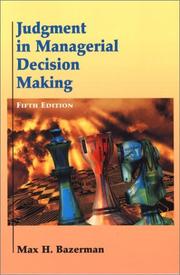
The biases that distort managers' decisions, with exercises that show them.
“Max Bazerman, Judgment in Managerial Decision Making, 4th ed. (New York: John Wiley & Son, 1998), 6-17” — Michael Mauboussin
Source: The Janitor’s Dream: Why Listening to Individuals Can be Hazardous to Your Wealth, page 3
Recommended by: Michael Mauboussin, Mohnish Pabrai and 1 other
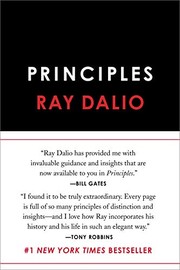
Decision rules from building Bridgewater: radical truth and radical transparency.
“Several people recommended Ray Dalio’s book Principles to me.” — Brad Feld
Source: Book: Principles by Ray Dalio — Feld Thoughts
Recommended by: Alfred Lin, Brad Feld, Derek Sivers and 31 others
Scenario planning: building strategic vision for business and life amid uncertainty.
Recommended by: Stewart Brand