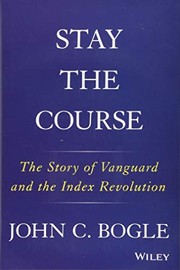
Stay the Course: The Story of Vanguard and the Index Revolution
Founder account of Vanguard, the mutual structure applied to fund management.
Summary
Bogle's late memoir covers the founding of Vanguard in 1974, the launch of the first retail index fund in 1976, the mutual ownership structure that made low fees permanent, and the firm's growth to more than five trillion dollars under management. It is organised partly chronologically and partly by fund, with chapters on the Wellington relationship, the bond funds, the money market funds and the international products.
The substantive argument is about structure. Bogle contends that Vanguard's mutual form, in which the funds own the management company and the management company operates at cost, is the only arrangement that reliably delivers low fees, because every other structure gives the manager a profit motive that conflicts with the investor. He documents the fee reductions over decades and argues they were possible only because there was no external owner to capture them.
The last section is a critique of what indexing became. Bogle objects to exchange-traded funds on the grounds that intraday tradability invites the behaviour that indexing was meant to prevent, and he raises the concentration problem, warning that a small number of index managers voting a majority of shares in every large company is a governance issue that will require a policy response. Those concerns are now mainstream. The book is repetitive, since Bogle covered this material in a dozen earlier books, and it is a self-account by the founder about his own firm, including his displacement from its leadership, so the internal conflicts are told from one side.
Key takeaways 7
- Vanguard's mutual ownership structure, in which the funds own the manager, is what makes permanently falling fees possible and cannot be replicated by a firm with outside shareholders.
- The first index fund raised only eleven million dollars against a three hundred million target, and the idea was rejected by the industry for years.
- Cost is the single determinant of relative fund performance over long periods, and the mathematics of the argument does not depend on any view about market efficiency.
- Exchange-traded funds encourage trading behaviour that destroys the benefit indexing was designed to deliver, whatever their headline expense ratios say.
- Concentration of index fund voting power in a few managers creates a corporate governance problem that will require regulation.
- Fund distribution economics, not investment merit, determined which products the industry sold for most of the twentieth century.
- An investment firm's structure predicts its behaviour more reliably than its stated principles do.
Who should read it
Investors interested in how fund company structure determines fee outcomes, and readers who want Bogle's own account of Vanguard and his late concerns about indexing.
About John C. Bogle
Founder and CEO, The Vanguard Group 1974-1996; creator of the first retail index mutual fund
He built the institution and wrote the primary-source case for low-cost indexing that every later index advocate builds on.
Who recommended it 1
Similar books 6
Chosen by shared topics, the entries that hold them, and the people who recommended both.
Vanguard's founder on costs, turnover and fund structure.
“Wonderful Book. I highly recommend all of John Bogle's writings to any investor.” — Mohnish Pabrai
Source: Mohnish's Bookshelf — Books on Investing & Capital Allocation, entry 50
Recommended by: Mohnish Pabrai, Jason Zweig and 3 others
The earlier, more instructional Bogle book on fund selection.
Recommended by: Mr. Money Mustache
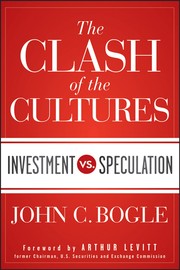
How speculation displaced long-term investment in markets, shown in turnover data.
“I also recommend The Clash of the Cultures by Jack Bogle” — Warren Buffett
Source: 2012 Berkshire Hathaway Shareholder Letter, p. 21
Recommended by: Mohnish Pabrai, Warren Buffett and 1 other
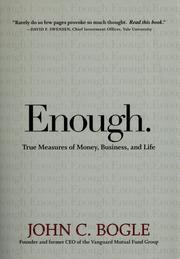
Recommended by: Mr. Money Mustache
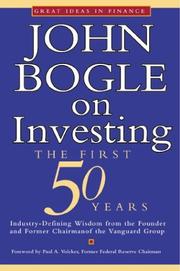
Fifty years of speeches and essays arguing for low-cost index funds.
Recommended by: Mohnish Pabrai, Mr. Money Mustache
Where it sits in the reference 4
Topics