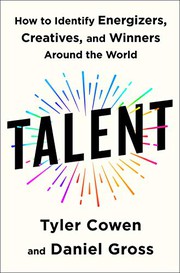
Talent
How to spot talent that resumes and standard interviews miss.
Summary
Cowen and Gross argue that identifying talented people is an underdeveloped skill and that the standard hiring apparatus of resumes, structured interviews and credentials is calibrated to identify competence rather than exceptional ability.
Their practical content is about interviewing differently. They argue for making the conversation genuinely unusual so that the candidate cannot deploy prepared answers, for asking questions that reveal how a person spends unstructured time, for asking what they believe that most people in their field disagree with, for probing the specifics of what they have actually built rather than the roles they have held, and for paying attention to energy and to the rate at which someone updates. They are direct that a structured interview optimised for fairness across candidates systematically screens out the outliers, which is a real trade-off rather than an implementation problem.
They also cover the identification of talent in unusual places: people without conventional credentials, people who are difficult, people whose track record is short but whose rate of improvement is steep, and people in geographies and demographics that standard sourcing does not reach, which they treat as the largest available arbitrage.
The book has no controlled evidence and the authors say so, drawing on their own records in venture investing and in Cowen's Emergent Ventures grant programme. It contradicts the selection research on structured interviewing, which is the strongest objection, and their answer is that the research measures average performance while they are hunting for outliers.
Key takeaways 7
- Standard hiring processes are calibrated to identify competence and systematically screen out the outliers who produce disproportionate results.
- Structured interviews optimised for fairness across candidates trade away the information that identifies exceptional people, which is a real trade-off rather than a flaw.
- How a person spends unstructured time reveals more about their drive and interests than any account of their professional roles.
- Asking what someone believes that most people in their field reject tests both independence and whether they have thought about the field at all.
- The rate at which a person improves matters more than their current level when the horizon is long.
- Talent in demographics and geographies that standard sourcing does not reach is the largest available arbitrage in hiring.
- The selection research supporting structured interviews measures average performance, which is a different objective from finding outliers.
Who should read it
Founders, investors and anyone hiring for roles where outlier performance matters more than reliable competence.
About Tyler Cowen
Professor of economics at George Mason University, director of the Mercatus Center and co-author of the Marginal Revolution blog.
The books apply price theory to questions operators actually face: which skills complement machines, how large firms really behave, why long-run growth should outrank near-term redistribution. Talent sets out a practical interviewing method for finding underrated people, drawn from his own grant-making at Emergent Ventures.
Who recommended it 1
Similar books 6
Chosen by shared topics, the entries that hold them, and the people who recommended both.
Work is splitting between those who work well with smart machines and the rest.
“Tyler Cowen, a professor of economics at George Mason University, dedicates a chapter to freestyle chess in his terrific book, Average Is Over.” — Michael Mauboussin
Source: Lessons from Freestyle Chess: Merging Fundamental and Quantitative Analysis, page 3
Recommended by: Michael Mauboussin, Ryan Holiday
A defence of American business on fraud, CEO pay, monopoly and tech, issue by issue.

Economics for daily life: motivating people, choosing food, giving to charity.
“Recommendations for the transactions of life. When to give to charity, what restaurants to choose, what insurance to buy, etc. He makes a rational case for these, often surprising, from an economics point of view.” — Derek Sivers
Source: Derek Sivers book notes (primary, rated list) · Rating: 8/10
Recommended by: Derek Sivers, Graham Duncan

Hire by defining the results a role must deliver, not the skills on a CV.
“Great advice on hiring, but insanely repetitive. Maybe this was an editing mistake - that the exact same points are made over and over and over and over - often with the exact same words, sentences, even paragraphs. But those key points are great.” — Derek Sivers
Source: Derek Sivers book notes (primary, rated list) · Rating: 2/10
Recommended by: Derek Sivers, Patrick Collison

Why societies should put sustainable long-run growth almost above all else.
“Subtitle “A Vision for a Society of Free, Prosperous, and Responsible Individuals” gives a hint of its contents. I love these kinds of books: full of well-considered, smart, rational and surprising ideas from an economist.” — Derek Sivers
Source: Derek Sivers book notes (primary, rated list) · Rating: 8/10
Recommended by: Derek Sivers, Jackie Vullinghs and 1 other
Deliberate practice, not innate talent, explains world-class performance.
“Talent is not innate - it comes from thousands of hours of deliberate practice: focused improving of your shortcomings. That's it. If you can get past the first 20% of the book that just asks questions, the next 60% is quite good.” — Derek Sivers
Source: Derek Sivers book notes (primary, rated list) · Rating: 6/10
Recommended by: Derek Sivers, Michael Mauboussin and 3 others