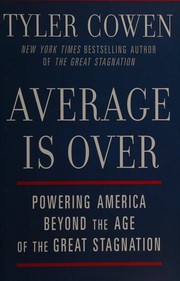
Average Is Over
Work is splitting between those who work well with smart machines and the rest.
Cowen on labour polarisation as machines take the middle
Summary
Cowen argues that the labour market is dividing between people who work effectively with intelligent machines and people who do not, and that this division will produce an increasingly unequal economy in which the middle disappears.
His central evidence is freestyle chess, in which humans partnered with computers compete against both unaided humans and unaided computers. Cowen reports that the winning combinations were frequently not the strongest human players or the strongest programs, but moderate players with good process for deciding when to accept and when to override the machine's suggestion. He generalises this into a claim about which human capabilities retain value: conscientiousness, the ability to work with measurement, the ability to know when to defer to a machine, and the marketing and interpretation of machine output.
He predicts a labour market in which roughly ten to fifteen percent of workers do very well, the remainder face stagnant or declining wages, and consumption patterns diverge sharply with cheap goods and services supporting a lower cost of living for the majority. His chapters on education predict the growth of online instruction combined with in-person coaching, and on science predict that machine-assisted analysis will change what problems are tractable.
The book was published in 2013 and predates current systems entirely, which makes some predictions look prescient and others dated. His freestyle chess evidence has weakened, since programs have improved to the point where human intervention now degrades performance. The general framework about which human contributions retain value is the durable part and the specific occupational predictions are not.
Key takeaways 8
- The labour market is dividing between people who work effectively with intelligent machines and people who do not.
- In freestyle chess the winning combinations were frequently moderate players with good process rather than the strongest humans or programs.
- Knowing when to accept and when to override a machine's output is the specific skill that determines whether the combination outperforms either alone.
- Conscientiousness and the ability to work with measurement retain value because they complement machine capability rather than competing with it.
- Roughly ten to fifteen percent of workers will do very well while the remainder face stagnant wages, which is Cowen's central prediction.
- Cheap goods and services will support a lower cost of living for the majority, which changes the political consequences of stagnant wages.
- Marketing and interpreting machine output for other people becomes a distinct occupation with substantial returns.
- The freestyle chess evidence has weakened since publication, since programs now perform worse when humans intervene.
Who should read it
Operators and investors thinking about which human capabilities retain value alongside machines, with the specific evidence treated as superseded.
About Tyler Cowen
Professor of economics at George Mason University, director of the Mercatus Center and co-author of the Marginal Revolution blog.
The books apply price theory to questions operators actually face: which skills complement machines, how large firms really behave, why long-run growth should outrank near-term redistribution. Talent sets out a practical interviewing method for finding underrated people, drawn from his own grant-making at Emergent Ventures.
Who recommended it 2 · 2 direct
“Tyler Cowen, a professor of economics at George Mason University, dedicates a chapter to freestyle chess in his terrific book, Average Is Over.”
Similar books 6
Chosen by shared topics, the entries that hold them, and the people who recommended both.
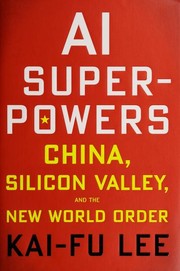
Why China may match the US in AI now that applying it matters more than research.
“Kai-Fu Lee, AI Superpowers: China, Silicon Valley, and the New World Order (Boston: Houghton Mifflin Harcourt Publishing, 2018), 22-26” — Michael Mauboussin
Source: One Job: Expectations and the Role of Intangible Investments, page 21
Recommended by: Balaji S. Srinivasan, Michael Mauboussin and 3 others
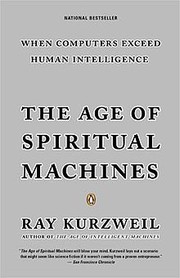
Predictions of computers passing the human brain and merging with human life.
“Ray Kurzweil, in his imagination-stretching book The Age of Spiritual Machines, suggests that it is possible to trace Moore’s Law, or some variant of it, back to about 1900.” — Michael Mauboussin
Source: Innovation and Markets: How Innovation Affects the Investing Process, page 13
Recommended by: Michael Mauboussin, Steve Jurvetson
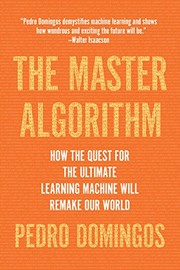
The five schools of machine learning, and the search for one algorithm to unite them.
“Pedro Domingos, The Master Algorithm: How the Quest for the Ultimate Learning Machine Will Remake Our World (New York: Basic Books, 2015)” — Michael Mauboussin
Source: How Well Do You Compare?, page 16
Recommended by: Michael Mauboussin, Shane Parrish and 2 others
Why America lost the ability to build housing, energy and infrastructure.
Recommended by: Andrew Wilkinson, Bill Gates
Why computers must recognise and express emotion to be intelligent.
“And so I was looking for a thesis topic and my fiance at the time went on Amazon and he said, "Oh, there's this really interesting book by this MIT professor called Rosalind Picard called Affective Computing.” — Rana el Kaliouby
Recommended by: Rana el Kaliouby

How overconsumption harms quality of life, work and family.
Recommended by: The Barefoot Investor