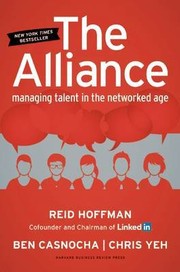
The Alliance
Employment as an honest alliance: set tours of duty between firm and employee.
Subtitled 'Managing Talent in the Networked Age'
Summary
Hoffman, Casnocha and Yeh argue that the employment relationship is dishonest on both sides, since companies talk about family and loyalty while conducting layoffs, and employees profess commitment while looking for their next role. They propose replacing this with an explicit alliance based on defined mutual investment over a stated period.
Their central mechanism is the tour of duty, meaning a specific commitment of two to four years with a defined mission that the employee is expected to accomplish and that will advance both the company and the employee's career. The terms are stated explicitly, including what the employee will achieve for the company and what capability, network or position they will gain in return. At the end of the tour the parties negotiate a new one or part on good terms.
They identify three types: rotational tours for entry-level roles with standard programmes, transformational tours built around a specific mission, and foundational tours for people whose career is committed to the company. Their second mechanism is deliberate network intelligence, meaning that employees should be encouraged and expected to build external networks and to bring information back, which the authors argue companies suppress out of fear of departures.
Their third is the corporate alumni network, treating departing employees as a continuing asset rather than as a loss, which they support with the recruiting, business development and information returns that firms including McKinsey obtain. The book is short and the framework is simple. The tour of duty requires a level of explicitness about departure that most managers avoid, which is the main obstacle. The alumni network argument is the least controversial and the most immediately actionable.
Key takeaways 8
- The employment relationship is dishonest on both sides, since companies invoke loyalty while conducting layoffs and employees profess commitment while looking elsewhere.
- An explicit alliance with defined mutual investment over a stated period replaces a relationship neither party believes.
- A tour of duty defines a specific mission over two to four years, including what the employee achieves and what capability they gain.
- Stating the terms of eventual departure at the outset produces more commitment during the period rather than less.
- Employees should be encouraged to build external networks and bring information back, which companies suppress out of fear of losing them.
- Departing employees are a continuing asset for recruiting, business development and market information rather than a loss.
- Alumni networks produce measurable returns, which firms including McKinsey have demonstrated over decades.
- The framework requires managers to be explicit about departure, which is the obstacle most of them will not overcome.
Who should read it
Managers and founders designing employment relationships who want an alternative to the loyalty framing that neither side believes.
About Reid Hoffman
Co-founder and former executive chairman of LinkedIn; partner at Greylock Partners; co-founder of Inflection AI
Blitzscaling and The Start-up of You outlived their news cycles and gave the industry durable vocabulary, on top of a first-rate operating and investing record.
Who recommended it 3 · 1 direct
“Reid Hoffman, Ben Casnocha, and Chris Yeh have written an outstanding and important book called The Alliance: Managing Talent in the Networked Age.”
Similar books 6
Chosen by shared topics, the entries that hold them, and the people who recommended both.
Why boards should manage talent with the rigour they give capital.
Recommended by: Keith Rabois
How Google hires, manages and pays its people, with the data behind each choice.
Recommended by: Mohnish Pabrai, Changpeng Zhao, David Cancel and 3 others

Hire by defining the results a role must deliver, not the skills on a CV.
“Great advice on hiring, but insanely repetitive. Maybe this was an editing mistake - that the exact same points are made over and over and over and over - often with the exact same words, sentences, even paragraphs. But those key points are great.” — Derek Sivers
Source: Derek Sivers book notes (primary, rated list) · Rating: 2/10
Recommended by: Derek Sivers, Patrick Collison
How organisations find exceptional talent before others do.
Recommended by: Mohnish Pabrai
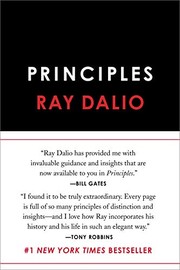
Decision rules from building Bridgewater: radical truth and radical transparency.
“Several people recommended Ray Dalio’s book Principles to me.” — Brad Feld
Source: Book: Principles by Ray Dalio — Feld Thoughts
Recommended by: Alfred Lin, Brad Feld, Derek Sivers and 31 others
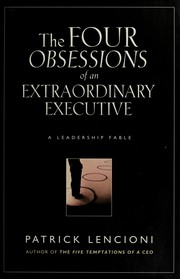
A fable of two rival firms showing why organisational health beats clever strategy.
Recommended by: Mohnish Pabrai, Ali Abdaal, Brian Armstrong