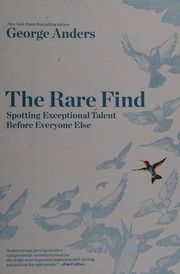
The Rare Find: Spotting Exceptional Talent Before Everyone Else
How organisations find exceptional talent before others do.
Summary
Anders, a journalist who covered venture capital and business for the Wall Street Journal, investigated how organisations that must find exceptional performers actually do it. He reports from Army Special Forces selection, Facebook's engineering recruitment, Teach for America, professional sports scouting, venture capital, orchestra auditions and surgical residencies.
The argument is that conventional hiring optimises for the absence of flaws, which selects for candidates who are broadly acceptable and rarely outstanding. Organisations that find exceptional people do the opposite. They first define which capabilities actually determine performance in the role, then accept serious weaknesses in every other area. Anders calls this the jagged resume, and he argues that the best candidates are frequently rejected by conventional screening because their record contains something disqualifying.
He identifies specific practices. Auditioning candidates on real work predicts better than interviews. Selection processes that create genuine stress reveal how people behave when tired and uncertain. Looking in places competitors ignore produces cheaper talent, which is why Special Forces recruits from unlikely backgrounds and why some venture investors back founders without pedigree. He also argues for taking the second look at candidates the process rejected, and for treating talent development as part of selection rather than as a later stage.
The evidence is reported case studies rather than data, and the selection of cases is not systematic. The book does not engage seriously with the industrial psychology literature on selection validity, which supports structured interviews and work samples and is more sceptical of the intuitive judgement some of his subjects rely on. Facebook's recruiting practices as described are also now dated.
Key takeaways 7
- Conventional hiring screens for the absence of weakness, which systematically excludes exceptional candidates.
- An organisation must define which two or three capabilities actually determine performance before it can hire well.
- Candidates with uneven records outperform candidates with uniformly acceptable ones in roles requiring exceptional output.
- Auditions on real work predict performance better than interviews about past work.
- Selection processes that induce fatigue and uncertainty reveal traits that comfortable interviews cannot.
- Recruiting from talent pools competitors ignore produces better candidates at lower cost.
- Rejected candidates deserve a second review, because the first screen encodes the organisation's blind spots.
Who should read it
Founders and hiring managers building teams where a few exceptional performers matter more than average quality across the group.
Who recommended it 1 · 1 direct
Similar books 6
Chosen by shared topics, the entries that hold them, and the people who recommended both.
How Google hires, manages and pays its people, with the data behind each choice.
Recommended by: Mohnish Pabrai, Changpeng Zhao, David Cancel and 3 others

Hire by defining the results a role must deliver, not the skills on a CV.
“Great advice on hiring, but insanely repetitive. Maybe this was an editing mistake - that the exact same points are made over and over and over and over - often with the exact same words, sentences, even paragraphs. But those key points are great.” — Derek Sivers
Source: Derek Sivers book notes (primary, rated list) · Rating: 2/10
Recommended by: Derek Sivers, Patrick Collison
Deliberate practice, not innate talent, explains world-class performance.
“Talent is not innate - it comes from thousands of hours of deliberate practice: focused improving of your shortcomings. That's it. If you can get past the first 20% of the book that just asks questions, the next 60% is quite good.” — Derek Sivers
Source: Derek Sivers book notes (primary, rated list) · Rating: 6/10
Recommended by: Derek Sivers, Michael Mauboussin and 3 others
Why boards should manage talent with the rigour they give capital.
Recommended by: Keith Rabois
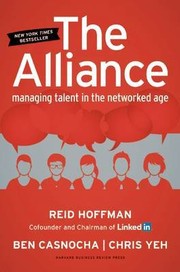
Employment as an honest alliance: set tours of duty between firm and employee.
“Reid Hoffman, Ben Casnocha, and Chris Yeh have written an outstanding and important book called The Alliance: Managing Talent in the Networked Age.” — Brad Feld
Source: Book: The Alliance — Feld Thoughts
Recommended by: Brad Feld, Brian Armstrong, Phil Libin
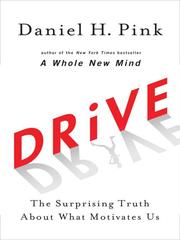
Rewards work for routine tasks; creative work runs on autonomy, mastery and purpose.
“Essential for all managers. Deep surprising study of motivation at work. Extrinsic vs intrinsic. Work vs play. When money is used as an external reward for some activity, the subjects lose intrinsic interest for the activity.” — Derek Sivers
Source: Derek Sivers book notes (primary, rated list) · Rating: 8/10
Recommended by: Derek Sivers, Michael Mauboussin and 4 others