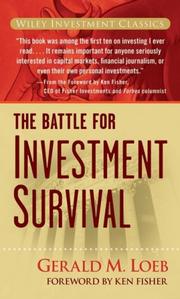
The Battle for Investment Survival
Against buy-and-hold: a few well-known positions, actively run, or else cash.
Depression-era trader on capital preservation and concentration
Summary
Loeb was a founding partner of E.F. Hutton and wrote this in 1935, having traded through the 1929 crash. Its position is the opposite of Graham's and it is worth reading for that contrast.
His central argument is that preservation of purchasing power is the objective and that diversification is a defence against ignorance rather than a source of returns. He advocates concentration in a small number of positions the investor knows well, active management of those positions, and a willingness to hold cash entirely when conditions are unattractive. He argues that most investors would do better with a few holdings they understand than with many they do not.
His risk management is a strict loss-cutting rule: sell any position that falls ten percent from cost, without exception and without reconsidering the thesis. His reasoning is that the loss itself is evidence the judgement was wrong, and that an investor who will not act on that evidence will eventually take a loss they cannot recover from.
He is also direct that investing is competitive, that the market is a contest against other participants who are working at least as hard, and that an investor without an edge should not participate.
The book is a period document and its specific market observations are ninety years old. Its concentration and loss-cutting positions are directly opposed to the value tradition's, and both approaches have produced good long-run records, which is itself instructive.
Key takeaways 7
- Preservation of purchasing power rather than nominal capital is the objective, which changes what counts as a safe asset.
- Diversification is a defence against ignorance rather than a source of return, and an investor should concentrate in positions they genuinely understand.
- Any position that falls ten percent from cost should be sold without exception, because the loss is evidence the judgement was wrong.
- An investor who will not act on evidence that they were wrong will eventually take a loss they cannot recover from.
- Holding cash entirely is a legitimate position when conditions are unattractive, and the inability to do so is a structural disadvantage professionals carry.
- Investing is a competitive activity against participants working at least as hard, and someone without an identifiable edge should not participate.
- This approach is directly opposed to the value tradition's, and both have produced good long-run records, which means neither is uniquely correct.
Who should read it
Investors who want a concentrated loss-cutting approach argued by a practitioner who traded through 1929, as a contrast to the value tradition.
Who recommended it 1 · 1 direct
Similar books 6
Chosen by shared topics, the entries that hold them, and the people who recommended both.
Second-level thinking, risk and market cycles, drawn from Oaktree's client memos.
“This is that rarity, a useful book.” — Warren Buffett
Source: The Most Important Thing — Columbia University Press
Recommended by: Matt Mullenweg, Mohnish Pabrai, Nat Eliason and 3 others
Avoid permanent loss: buy well below value and aim for absolute returns.
“Seth Klarman, the founder, chief executive, and portfolio manager of the very successful value investing firm The Baupost Group, shares a similar sentiment in his book Margin of Safety:22 It is not clear why investors suddenly came to accept EBITDA as a measure of corporate cash flow.” — Michael Mauboussin
Source: What Does an EV/EBITDA Multiple Mean?, page 4
Recommended by: Arnold Van Den Berg, Frank Martin, Guy Spier and 7 others

Short numbered lessons on life and investing, written for two daughters.
“A nice short book of unconventional wisdom, mostly about investing.” — Derek Sivers
Source: Derek Sivers book notes (primary, rated list) · Rating: 3/10
Recommended by: Derek Sivers, Mohnish Pabrai
What markets looked like at the US stock bottoms of 1921, 1932, 1949 and 1982.
Data showing that low-expectation stocks beat popular ones over the long run.
“all these people really were helpful in forming and getting me involved in investing” — Joel Greenblatt
Source: Masters in Business transcript: Joel Greenblatt (2018)
Recommended by: Joel Greenblatt, Michael Mauboussin and 2 others
Interviews with fifteen hedge fund managers with strong long-term records.
“Being a big fan of Jack Schwager’s Wizard series of investment books, I eagerly read his newest book, Hedge Fund Market Wizards, and was not disappointed.” — Bill Nygren
Source: Bill Nygren Market Commentary | 2Q12
Recommended by: Bill Nygren, Michael Mauboussin
Where it sits in the reference 2
Topics 1
As an Amazon Associate I earn from qualifying purchases.