Updates

  1. Person pages list letters, writing, profiles and links as sortable tables with filters, and show each person's companies as links; Fund letters show each letter's description in its own column.
  2. Experts show a checked job title and a short description of each person; 30 more people have photographs.
  3. Every company, fund, university and publication the experts work for has a page listing the people there.
  4. Fund letters show each letter's thesis and filter by it; 225 person pages list the essays, columns and newsletter issues the person wrote.
  5. Person pages list every essay and newsletter issue a person wrote, and their own books as a table in List view.
  6. Recommends shows the five largest kinds of book and the rest under More; browse pictures load sooner.
  7. Podcasts and talks link the original episode, filter by Audio and video or Press, and list each publisher once.
  8. Pages are wider, Recommends has List and Grid, and a filter clicked again turns off.
  9. Book cards sit in a ruled grid with Open Library and Goodreads links and each book's one-line note.
  10. Funds is now Investors; each investor's styles are buttons that filter the table.
  11. Podcasts and talks on a person's page filter by year and publisher and show as a list or a grid of pictures.
  12. Quotes show only people's own words: 472 summaries written by list sites are gone.
  13. Country pages open from Browse again, and every link on the shelf lands on a page.
  14. Subject and person pages show their sections as tabs, and each book appears once on a person's page.
  15. Book cards show the quote, who said it and the source; grids show five cards to a row.
  16. On a phone, a menu holds the sections, search, Updates, Feedback and dark mode.
  17. Feedback takes a screenshot of the page with no browser prompt, opens a screenshot full size when you click it, and clears itself once sent.
  18. Book cards are centred, search names the topic each book sits in, and any text cut short shows whole on hover.
  19. Search groups its results by kind: people, companies, geographies, subjects, topics, books, funds, fund letters and papers.
  20. The Books table lists who recommended each book by name, and the browser tab names the section you are in.
  21. Feedback can take a screenshot of the page, or one you paste or choose, and opens in the corner beside Updates.
  22. Each rail button reopens its section where you left it, and Browse, Table and People show on every book and subject page.
  23. Filters grey out choices that hold nothing instead of hiding them, and Books › People filters by authors or recommenders.
  24. Feedback takes a subject line and up to three screenshots.
  25. Biographies are grouped by the person they are about: 41 new pages, from Abraham Lincoln to Lee Kuan Yew.
  26. Sport splits into 23 sports, and Religion into one topic per faith.
  27. Book lists show as cards: the cover, one recommendation quote and every recommender by name.
  28. Seventeen subjects that had two or three pages under different names now have one page each.
  29. Every page lists its Experts as authors and recommenders, with a link to them on the Experts tab.
  30. Economics, Financial history, Financial panics and Accounting are subjects of their own, with one page per financial crisis.
  31. Book, person and subject pages open inside the app, so the tabs stay in view.
  32. 996 more book covers, and photographs or logos for 227 more people and companies.
  33. Books › Browse shows every subject as cards, and the rail holds Fund letters, Papers, Experts, Books and Funds.
  34. Every topic over 150 books splits into narrower topics, each with a page of its own.

Send feedback

What is it?
Screenshots, up to 3 (optional)
or paste one with Ctrl+V

We use your email only to reply to you.

The Bogle Effect: How John Bogle and Vanguar

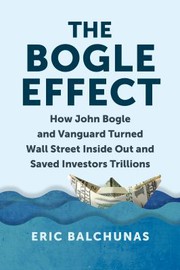
The Bogle Effect: How John Bogle and Vanguard Turned Wall Street Inside Out and Saved Investors Trillions

Eric Balchunas
2022
T3 288 pages · about 4h 48m to read Open Librarygoodreads

Bloomberg analyst on Vanguard's economics

Summary

Balchunas, a Bloomberg exchange-traded fund analyst, wrote about John Bogle's effect on the asset management industry rather than a biography, drawing on interviews with Bogle before his death and on industry data.

His central quantitative argument is the estimate he calls the Bogle effect: the amount investors save annually because of the fee compression Vanguard forced across the whole industry, which he puts at roughly a quarter of a trillion dollars a year when the fees actually charged are compared with what would have been charged at earlier rates. He argues that the savings to investors outside Vanguard exceed those to Vanguard's own clients, because competitors cut fees to retain assets.

The structural analysis covers the mutual ownership arrangement, in which the funds own the management company so surpluses return to shareholders as lower costs, and Balchunas argues this is unreplicable: no competitor can adopt it without destroying its own economics, which is why the advantage has held.

He also covers what he calls the Vanguard effect on flows, the growth of index funds to a majority of American equity fund assets, the exchange-traded fund business and Vanguard's unusual share-class structure, and the areas where Bogle's own views and the industry diverged, particularly Bogle's opposition to exchange-traded funds on the grounds that tradability encourages the behaviour indexing was meant to prevent.

Balchunas addresses the criticisms of index concentration, including the common ownership arguments and the governance questions raised by three firms holding large stakes in most public companies, though not at length.

The book is admiring and written by someone who covers the industry professionally. The fee savings estimate depends on a counterfactual about what fees would otherwise have been, which cannot be verified. It is more analytical and more distant than Ellis's Inside Vanguard, also in this reference.

Key takeaways 7

  1. Fee compression forced by Vanguard saves investors across the whole industry more than it saves Vanguard's own clients.
  2. The mutual ownership structure cannot be copied by a competitor without destroying that competitor's existing economics.
  3. Index funds passed active funds as a share of American equity fund assets, which reversed the industry's structure within one career.
  4. Bogle opposed exchange-traded funds because tradability encourages the trading behaviour that indexing was designed to prevent.
  5. Vanguard's exchange-traded funds were structured as share classes of existing mutual funds, which no competitor could replicate.
  6. A cost advantage that grows with scale is more durable than any advantage based on investment performance.
  7. Concentration of index assets in a few managers raises governance questions that the cost savings do not answer.

Who should read it

Investors and asset management operators who want the industry-wide effect of indexing quantified and the structural reasons the advantage persists.

Similar books 6

Chosen by shared topics, the entries that hold them, and the people who recommended both.
Robert Slater · 1996

The only biography; stops two decades before indexing won.
Cornelius C. Bond · 2019

Biography of the man who named and institutionalised growth investing.
John C. Bogle · 1999

Vanguard's founder on costs, turnover and fund structure.

“Wonderful Book. I highly recommend all of John Bogle's writings to any investor.” — Mohnish Pabrai

Source: Mohnish's Bookshelf — Books on Investing & Capital Allocation, entry 50

Recommended by: Mohnish Pabrai, Jason Zweig and 3 others

John C. Bogle · 1992

Newcomen Society address, short monograph

Where it sits in the reference 3

Companies
Biographies
Industries

Topics

Biography and MemoirInvestingCompany HistoriesInvestors, Traders and Gamblers