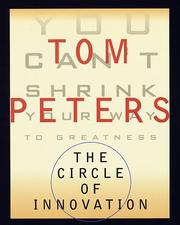
The Circle of Innovation: You Can't Shrink You Way to Greatness
Cost-cutting can't produce growth; a company must stand out to win.
Summary
Peters argues that cost reduction and efficiency cannot produce growth, that a company which competes on being cheaper is competing on the one dimension where someone will always beat it, and that the alternative is distinctiveness.
His specific arguments include: that every function in a company should be treated as a business that could be sold externally, which forces each to be excellent rather than merely internal; that professional service firms are the organisational model, since they organise around projects and around talent rather than around permanent functions; that design and the emotional response to a product determine purchase once functional parity exists; that brand applies to individuals as well as companies, which is the argument he made famous as the brand called you; that systems and processes should be radically simplified because complexity is where cost and delay accumulate; and that distribution and the customer relationship are worth more than the product.
The book is presented as fifteen chapters derived from a seminar and uses the aggressive typography and layout Peters adopted in this period.
There is no evidence base and the argument proceeds by assertion, example and repetition. Peters is a provocateur and states positions absolutely. The observation that efficiency competition has no endpoint and that distinctiveness is the alternative is correct and is stated more rigorously elsewhere, notably in Porter. Its value is as motivation rather than analysis, and readers who find the presentation style unbearable should not persist.
Key takeaways 7
- Cost reduction cannot produce growth, and competing on being cheaper means competing on the one dimension where someone will always win eventually.
- Every internal function should be able to survive as an external business, which is the test of whether it is excellent or merely present.
- Design and the emotional response to a product determine purchase once competing products reach functional parity.
- Professional service firms are the organisational model, since they assemble around projects and talent rather than around permanent functions.
- Complexity in systems and processes is where cost and delay accumulate, so simplification is a strategic rather than an administrative activity.
- Distribution and the customer relationship are worth more than the product, because the product can be replicated and the relationship cannot.
- Individuals as well as companies must be distinctive, since the same competitive logic applies to a career as to a business.
Who should read it
Readers wanting motivation to compete on distinctiveness rather than cost, with the analytical version of the argument available in Porter.
About Tom Peters
American management writer and former McKinsey consultant who co-wrote In Search of Excellence and built a long practice in management speaking.
In Search of Excellence pulled management writing away from portfolio matrices and toward observable practices at operating companies, and the later books press the same emphasis on execution, customer obsession and organisational energy. Operators read the collections for concrete habits to copy rather than for a framework to fill in.
Who recommended it 1 · 1 direct
Similar books 6
Chosen by shared topics, the entries that hold them, and the people who recommended both.
210 short pieces of business advice for a fast-changing early-1990s economy.
Recommended by: Mohnish Pabrai
A manifesto to rebuild firms for an age of automated white-collar work and design.
“Too many great Tom Peters books, start with this one.” — David Cancel
Source: The Books Every Startup CEO Should Read — David Cancel, Medium
Recommended by: David Cancel
Why imitating others' innovations matters as much as innovating.
Recommended by: Mohnish Pabrai
Why long-lived companies underperform the market, and how to transform them.
“Richard Foster and Sarah Kaplan, Creative Destruction (New York: Doubleday, 2001)” — Michael Mauboussin
Source: Innovation and Markets: How Innovation Affects the Investing Process, page 20
Recommended by: Michael Mauboussin, Mohnish Pabrai
Strategies for firms that imitate other companies' innovations.
Recommended by: Mohnish Pabrai
How companies lead markets by producing a steady stream of new products.
Recommended by: Mohnish Pabrai