
The Cold Start Problem
How to launch a network product that is worthless until enough people use it.
Free tiers used as the tool for reaching network critical mass.
Summary
Chen, a partner at Andreessen Horowitz who previously worked at Uber, addresses the specific problem of launching a network product that has no value until other people are using it.
His framework has five stages. The cold start problem itself, where the product is worthless until a minimum viable network exists, and the solution is to build the smallest network that provides value to its members, which he calls an atomic network, and to build many of these rather than trying to grow one large one. The tipping point, where the product acquires networks faster than it loses them, achieved through mechanisms including invitations, paid acquisition against known lifetime value, and what he calls the come for the tool stay for the network approach. Escape velocity, where growth becomes self-sustaining through the acquisition, engagement and economic effects operating together. The ceiling, where growth stalls because of market saturation, spam, degraded quality or overcrowding of the network. And the moat, where network effects become defensive against competitors.
The specific content on atomic networks is the most useful part. Chen's argument that Uber launched city by city and even neighbourhood by neighbourhood, and that a network product's minimum viable unit is far smaller than founders assume, is directly applicable.
The book draws on Chen's own experience and on interviews with operators at network companies. It is practitioner synthesis rather than research, the failure cases receive less attention than the successes, and the venture capital vantage point shapes which examples appear.
Key takeaways 7
- A network product must first build the smallest network that provides value to its own members rather than attempting to grow one large network.
- The minimum viable network is far smaller than founders assume, which is why launching city by city or campus by campus works.
- Building many small networks separately and then connecting them is more reliable than growing a single network from the centre.
- Offering a useful single-player tool first, with the network arriving later, solves the cold start problem for products that permit it.
- Growth stalls at a ceiling caused by saturation, spam, quality degradation or network overcrowding, and each requires a different response.
- Network effects become defensive only after the network is dense enough that a competitor cannot assemble an equivalent one.
- The economic effect of a network, meaning improving unit economics as it grows, is distinct from the acquisition and engagement effects and arrives last.
Who should read it
Founders and investors building or evaluating network products who need a staged framework for the launch and growth problems specific to them.
Who recommended it 2
Similar books 6
Chosen by shared topics, the entries that hold them, and the people who recommended both.
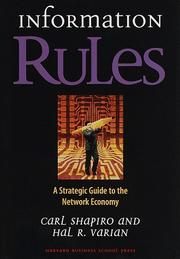
Economics for information goods: pricing, versioning, lock-in and network effects.
“Carl Shapiro and Hal R. Varian, Information Rules (Boston, MA: Harvard Business School Press, 1999), 174” — Michael Mauboussin
Source: The Ecosystem Edge, page 10
Recommended by: Michael Mauboussin, Mohnish Pabrai and 1 other
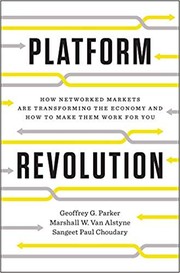
How platforms create value by matching groups, unlike linear pipeline businesses.
Recommended by: Reid Hoffman

Digital costs near zero mean goods can be given away, which changes whole industries.
“During the month I read Chris Anderson’s excellent 2009 book “Free” and found in it a lot of sense about the way the business world is today and where it’s going – certainly more sense than I get from watching a Bloomberg scr” — Nick Train
Source: April 2016 Monthly Manager Report, page 2
Recommended by: Nick Train

The arithmetic of freemium businesses: conversion, lifetime value and whales.
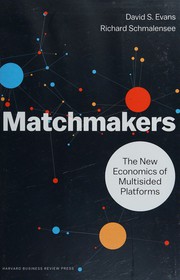
How multi-sided platforms such as card networks get both sides on board at once.
“David S. Evans and Richard Schmalensee, Matchmakers: The New Economics of Multisided Platforms (Boston, MA: Harvard Business Review Press, 2016)” — Michael Mauboussin
Source: Measuring the Moat: Assessing the Magnitude and Sustainability of Value Creation
Recommended by: Michael Mauboussin
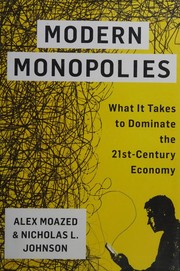
How platform businesses connecting users differ from firms that make products.
“Alex Moazed and Nicholas L. Johnson, Modern Monopolies: What It Takes to Dominate in the 21st Century (New York: St. Martin’s Press, 2016)” — Michael Mauboussin
Source: Measuring the Moat: Assessing the Magnitude and Sustainability of Value Creation
Recommended by: Michael Mauboussin