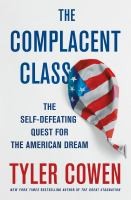
The Complacent Class: The Self-Defeating Quest for the American Dream
How Americans became less willing to move, take risks and adapt.
Summary
Tyler Cowen, the economist and blogger, starts from Alexis de Tocqueville's observation that restlessness is a signature American trait: a willingness to move, take risks and adapt that produced a dynamic economy and innovators from Ben Franklin to Steve Jobs. His argument is that Americans have broken with that tradition and now work harder than ever to avoid change.
Americans move house less, marry people more like themselves and choose music and partners by algorithms that wall them off from the new and different: Match.com in love, Spotify and Pandora in music, Facebook in almost everything else. This matching culture brings real benefits, Cowen grants, in comfort and satisfaction, but also heightened inequality and segregation and weaker incentives to innovate and create. He argues the stagnation cannot last: postponing change out of short-sightedness and a desire for comfort will make it harder when it comes, and he predicts that it will lead to a fiscal and budgetary crisis and to impossibly expensive rents in the most attractive cities.
Key takeaways 4
- Americans have become less mobile and less willing to take risks.
- Algorithms that match people to what they already like reduce exposure to the new.
- Comfort brings costs in inequality, segregation and slower innovation.
- Cowen predicts that postponed change will arrive as crisis.
Who should read it
Readers interested in economics, social trends and the slowdown of American dynamism.
About Tyler Cowen
Professor of economics at George Mason University, director of the Mercatus Center and co-author of the Marginal Revolution blog.
The books apply price theory to questions operators actually face: which skills complement machines, how large firms really behave, why long-run growth should outrank near-term redistribution. Talent sets out a practical interviewing method for finding underrated people, drawn from his own grant-making at Emergent Ventures.
Who recommended it 3 · 3 direct
“America’s dynamic ever-changing past is slowing into a complacent stagnation. People don’t move as much or expect change. This hurts class mobility, and eventually needs to change. Inspired by his visit to China, which has grown 10% every year for 30 years, meaning every 7 years it’s like a whole new country is built. America is relatively halted.”
Similar books 6
Chosen by shared topics, the entries that hold them, and the people who recommended both.
Over one hundred essays on twentieth-century thinkers, artists and musicians.
“It's a book by a writer called Clive James and it is called Cultural Amnesia. And, first off, he is so learned that you just want to read what he has to say, and I assume he's not making this up, but he says, well, I wanted to read Proust, but I didn't know French so I started with [inaudible] and start learning French.” — Frank Blake
Source: The Tim Ferriss Show Transcripts: Frank Blake (#303)
Recommended by: Frank Blake, Patrick Collison

A collection of essays, including the one known as the Harper's essay.
Recommended by: Patrick Collison
Essays for reflection and free enquiry, from fascism's roots to "useless" knowledge.
Recommended by: Nat Eliason, Patrick Collison, Ed Cooke
Essays on carnival hokum, magical thinking and Washington's cult of expertise.
Recommended by: Patrick Collison