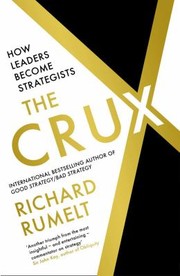
The Crux
How leaders become strategists by finding the crux of a challenge.
Subtitled How Leaders Become Strategists
Summary
Richard Rumelt follows Good Strategy Bad Strategy with a book about how a strategist actually works. His central concept is the crux: the one challenge within a difficult situation that is both critical and addressable, and identifying it is the strategist's real work.
His argument is that most strategy processes fail because they begin with goals. A company sets a growth target and then works backward, which produces a list of aspirations rather than a strategy. Rumelt insists that strategy begins with diagnosis: understanding what is actually happening, identifying the obstacles, and then finding among them the one that can be solved and whose solution unblocks the rest. A challenge that cannot be addressed with available resources is not the crux, however important it is.
The method he describes involves working through a set of candidate challenges, assessing each for importance and for solvability, and resisting the urge to address everything. He works through cases, and the book's structure follows him thinking through real situations rather than presenting finished frameworks. He is dismissive of strategic planning processes, of vision statements, of financial targets presented as strategy, and of consultants' frameworks applied without diagnosis. The book is repetitive in places and its cases are sometimes thin, but the crux concept is a genuine contribution and the insistence on diagnosis before action is the discipline most organisations lack.
Key takeaways 7
- Strategy begins with diagnosis of what is actually happening rather than with a goal or a target.
- The crux is the challenge that is both critical to the situation and addressable with available resources.
- An important challenge that cannot be addressed is not the crux, and treating it as one produces paralysis.
- Financial targets and vision statements are not strategy, because neither specifies what will be done differently.
- A strategist must choose one challenge to attack, since addressing everything dissipates the resources that would solve anything.
- Rumelt argues that solving the crux unblocks the other challenges, which is what distinguishes it from an ordinary problem.
- Working through a situation requires holding several candidate diagnoses simultaneously before committing to one.
Who should read it
Executives and founders responsible for strategy who want a method for diagnosis rather than another planning framework.
About Richard Rumelt
Harry and Elsa Kunin Professor Emeritus of Business and Society, UCLA Anderson School of Management; previously INSEAD and Harvard Business School
Good Strategy Bad Strategy is the standard reference for what a strategy actually is, and his 1974 diversification study founded an empirical literature.
Similar books 6
Chosen by shared topics, the entries that hold them, and the people who recommended both.
Why most so-called strategies are not, and the three-part kernel real ones need.
“Rumelt, Richard P., Good Strategy Bad Strategy: The Difference and Why It Matters (New York: Crown Business, 2011)” — Michael Mauboussin
Source: Measuring the Moat: Assessing the Magnitude and Sustainability of Value Creation, page 65
Recommended by: Michael Mauboussin, Ann Handley and 3 others
Whether a firm's diversification strategy predicts its financial results.
The deal is shaped before the table: set up the parties, interests and options first.
Seven sources of lasting advantage, each a benefit plus a barrier to rivals.
Recommended by: Keith Rabois, Alex Lieberman, Brett Adcock and 6 others
How to create new market space instead of fighting rivals over existing demand.
“It's the epitome of Blue Ocean Strategy. To find a breakthrough angle in commerce, it's as important to decide where you will not compete, as it is to decide where you will compete.” — David Heinemeier Hansson
Source: Turns out nobody cared about panel gaps
Recommended by: David Heinemeier Hansson, Mohnish Pabrai and 6 others
Teaching cases for applying the framework of Competitive Strategy.
Where it sits in the reference 3
Topics 1
As an Amazon Associate I earn from qualifying purchases.