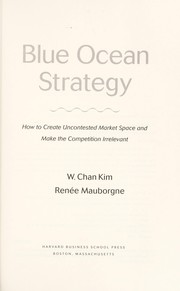
Blue Ocean Strategy: How to Create Uncontested Market Space and Make Competition Irrelevant
How to create new market space instead of fighting rivals over existing demand.
Summary
Kim and Mauborgne distinguish red oceans, meaning existing industries where competitors fight over known demand, from blue oceans, meaning uncontested market space created by redefining the boundaries of an industry. Their argument is that competing on the existing terms produces margin compression, and that the alternative is what they call value innovation, meaning simultaneously raising buyer value and lowering cost by changing what the industry offers.
The analytical tools are the book's contribution. The strategy canvas plots the factors an industry competes on against the level offered, which makes an existing competitive convergence visible. The four actions framework asks which factors should be eliminated, reduced, raised and created, and the eliminate-reduce-raise-create grid forces answers to all four rather than only the additive ones. They also give the six paths framework for looking across industries, groups, buyer chains, complementary offerings, functional and emotional appeal, and time.
The cases include Cirque du Soleil, which removed animals and star performers while adding theatrical production, Southwest Airlines, Yellow Tail wine, Curves and Nintendo Wii.
The research base is the weak point. The authors studied one hundred and fifty strategic moves across thirty industries over a century, selecting successful cases and identifying common features, which cannot show how many failed attempts shared them. Several celebrated examples have since struggled. The framework does not explain how to identify a blue ocean in advance, only how to describe one after it exists. The strategy canvas remains genuinely useful as a diagnostic, because it makes competitive convergence visible in a way that most internal discussions do not.
Key takeaways 8
- Competing within an industry's existing terms compresses margins for everyone, because rivals converge on the same factors.
- Value innovation means raising buyer value and reducing cost at the same time, which requires changing what the industry offers rather than trading one against the other.
- Plotting the factors an industry competes on reveals that competitors have converged, which most internal strategy discussions never make visible.
- A company must decide what to eliminate and reduce, not only what to raise and create, and the removals are what make the cost reduction possible.
- Demand can be created rather than divided, by reaching people who currently do not buy from the industry at all.
- New market space is usually found by looking across industry boundaries, buyer groups or complementary offerings rather than within the existing definition.
- Execution requires overcoming organisational, resource, motivational and political barriers, which the authors treat as a distinct problem from strategy formulation.
- The framework describes successful moves after the fact and does not provide a method for identifying which new positions will work.
Who should read it
Founders and executives whose market has converged on the same competitive factors, who need a diagnostic for what to remove as well as what to add.
Who recommended it 8 · 4 direct
“It's the epitome of Blue Ocean Strategy. To find a breakthrough angle in commerce, it's as important to decide where you will not compete, as it is to decide where you will compete.”
Similar books 6
Chosen by shared topics, the entries that hold them, and the people who recommended both.
How to spot a strategic inflection point, when a tenfold force changes a business.
“There's also a number of great books that just tell the narrative of one company, such as The New New Thing, Startup, eBoys, Only the Paranoid Survive, Breaking Windows, but I've left those off the list even though they are very fun to read.” — Andrew Chen
Source: Ten classic books that define tech
Recommended by: Andrew Chen, Charlie Munger, Jim Collins and 12 others
Game theory applied to business, which is cooperative and competitive at once.
“Adam M. Brandenburger and Barry J. Nalebuff, Co-opetition (New York: Currency Doubleday, 1996)” — Michael Mauboussin
Source: The Ecosystem Edge, page 10
Recommended by: Michael Mauboussin, Mohnish Pabrai
How firms lead future industries by seeing tomorrow's chances and building skills.
Recommended by: Mohnish Pabrai
Strategy as constant reshaping of advantage in fast, unpredictable markets.
Recommended by: Mohnish Pabrai
Why barriers to entry are the one force that matters in business strategy.
“Bruce Greenwald and Judd Kahn, Competition Demystified: A Radically Simplified Approach to Business Strategy (New York: Portfolio, 2005), 52-76” — Michael Mauboussin
Source: New Business Boom and Bust: How Capitalism Experiments, page 9
Recommended by: Li Lu, Michael Mauboussin, Mohnish Pabrai
The five forces model for analysing an industry and a firm's place in it.
“For example, I read Competitive Strategy and Competitive Advantage by Michael Porter.” — Michael Mauboussin
Source: Thirty Years: Reflections on the Ten Attributes of Great Investors, page 3
Recommended by: Jim Collins, Michael Mauboussin and 3 others
Where it sits in the reference 2
Topics 1
As an Amazon Associate I earn from qualifying purchases.