Updates

  1. Person pages list letters, writing, profiles and links as sortable tables with filters, and show each person's companies as links; Fund letters show each letter's description in its own column.
  2. Experts show a checked job title and a short description of each person; 30 more people have photographs.
  3. Every company, fund, university and publication the experts work for has a page listing the people there.
  4. Fund letters show each letter's thesis and filter by it; 225 person pages list the essays, columns and newsletter issues the person wrote.
  5. Person pages list every essay and newsletter issue a person wrote, and their own books as a table in List view.
  6. Recommends shows the five largest kinds of book and the rest under More; browse pictures load sooner.
  7. Podcasts and talks link the original episode, filter by Audio and video or Press, and list each publisher once.
  8. Pages are wider, Recommends has List and Grid, and a filter clicked again turns off.
  9. Book cards sit in a ruled grid with Open Library and Goodreads links and each book's one-line note.
  10. Funds is now Investors; each investor's styles are buttons that filter the table.
  11. Podcasts and talks on a person's page filter by year and publisher and show as a list or a grid of pictures.
  12. Quotes show only people's own words: 472 summaries written by list sites are gone.
  13. Country pages open from Browse again, and every link on the shelf lands on a page.
  14. Subject and person pages show their sections as tabs, and each book appears once on a person's page.
  15. Book cards show the quote, who said it and the source; grids show five cards to a row.
  16. On a phone, a menu holds the sections, search, Updates, Feedback and dark mode.
  17. Feedback takes a screenshot of the page with no browser prompt, opens a screenshot full size when you click it, and clears itself once sent.
  18. Book cards are centred, search names the topic each book sits in, and any text cut short shows whole on hover.
  19. Search groups its results by kind: people, companies, geographies, subjects, topics, books, funds, fund letters and papers.
  20. The Books table lists who recommended each book by name, and the browser tab names the section you are in.
  21. Feedback can take a screenshot of the page, or one you paste or choose, and opens in the corner beside Updates.
  22. Each rail button reopens its section where you left it, and Browse, Table and People show on every book and subject page.
  23. Filters grey out choices that hold nothing instead of hiding them, and Books › People filters by authors or recommenders.
  24. Feedback takes a subject line and up to three screenshots.
  25. Biographies are grouped by the person they are about: 41 new pages, from Abraham Lincoln to Lee Kuan Yew.
  26. Sport splits into 23 sports, and Religion into one topic per faith.
  27. Book lists show as cards: the cover, one recommendation quote and every recommender by name.
  28. Seventeen subjects that had two or three pages under different names now have one page each.
  29. Every page lists its Experts as authors and recommenders, with a link to them on the Experts tab.
  30. Economics, Financial history, Financial panics and Accounting are subjects of their own, with one page per financial crisis.
  31. Book, person and subject pages open inside the app, so the tabs stay in view.
  32. 996 more book covers, and photographs or logos for 227 more people and companies.
  33. Books › Browse shows every subject as cards, and the rail holds Fund letters, Papers, Experts, Books and Funds.
  34. Every topic over 150 books splits into narrower topics, each with a page of its own.

Send feedback

What is it?
Screenshots, up to 3 (optional)
or paste one with Ctrl+V

We use your email only to reply to you.

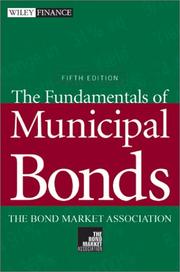
The Fundamentals of Municipal Bonds

The Fundamentals of Municipal Bonds

Judy Wesalo Temel
2001
T3 281 pages · about 4h 41m to read Open Librarygoodreads

The Bond Market Association's primer; the standard entry point.

Summary

This is the reference work on American municipal bonds, produced by the Securities Industry and Financial Markets Association and its predecessor and revised across editions. Judy Wesalo Temel edited the fifth edition.

The content covers the market systematically. It sets out the issuers, from states and cities through school districts, utilities, transport authorities and conduit issuers on behalf of hospitals and universities. It distinguishes general obligation bonds, backed by taxing power, from revenue bonds, backed by a specific project's receipts, and explains the credit analysis each requires. It covers the tax exemption that defines the market, the federal rules governing which issues qualify, the alternative minimum tax treatment, and the state tax position. It covers the issuance process including the roles of underwriters, bond counsel and financial advisers, competitive versus negotiated sale, and official statement disclosure.

The analytical chapters cover credit ratings and their meaning in the municipal context, insurance and its collapse after 2008 when the monoline insurers lost their own ratings, derivatives and swaps used by issuers, the secondary market and its illiquidity, and the disclosure regime under Rule 15c2-12. The book is written for practitioners and assumes a working knowledge of fixed income. Editions matter, since tax law, the insurance market and disclosure requirements have all changed materially.

Key takeaways 7

  1. General obligation bonds are backed by taxing power while revenue bonds are backed by a specific project's receipts, and the credit analysis differs entirely.
  2. Federal tax exemption defines the municipal market, and the rules determining which issues qualify shape what gets financed.
  3. Bond insurance collapsed as a credit enhancement after 2008 because the insurers lost the ratings they were selling.
  4. Municipal credit ratings historically used a different scale from corporate ratings, which made comparison across markets misleading.
  5. The secondary market in municipals is illiquid and priced by dealers, so retail investors pay spreads they cannot observe.
  6. Conduit issuers lend their tax exemption to private borrowers including hospitals and universities, whose credit is what actually backs the bond.
  7. Disclosure in the municipal market is governed by a rule imposed on underwriters rather than by direct issuer obligation.

Who should read it

Practitioners and investors in American municipal debt who need the market's structure, tax rules and credit analysis in one reference.

Similar books 6

Chosen by shared topics, the entries that hold them, and the people who recommended both.
Annette Thau · 1991

Retail-investor guide with the clearest chapters on buying munis.

Triet Nguyen · 2012

The distressed and non-rated end of the muni market.

Sylvan G. Feldstein, Frank J. Fabozzi · 2008

A reference on municipal bonds: credit analysis, structures and analytics.
Michael Lewis · 2011

How Iceland, Greece, Ireland, Germany and California each spent cheap credit.

Nathan Bomey · 2016

Detroit's Chapter 9 bankruptcy, the largest by a US city, from inside the case.

Kim Phillips-Fein · 2017

New York's 1975 fiscal crisis and the austerity politics it taught the nation.

Where it sits in the reference 1

Assets

Topics

Finance and MarketsInvesting