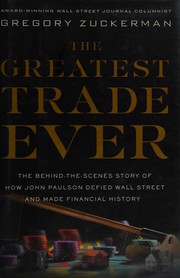
The Greatest Trade Ever
John Paulson's subprime short.
Summary
Zuckerman documents John Paulson's construction of the subprime short that produced roughly fifteen billion dollars for his funds in 2007, and covers several other investors who reached the same conclusion including Michael Burry, Greg Lippmann, Jeffrey Greene and Andrew Lahde.
The analytical material covers how the position was constructed. Paulson's team examined the underlying loan characteristics in mortgage pools, concluded that default rates would rise sharply if house prices merely stopped rising rather than needing to fall, and identified credit default swaps on subprime mortgage securities as the instrument that expressed the view with defined downside and enormous upside. The asymmetry is the point: the premiums cost a small percentage annually and the payoff on default was the full notional.
The practical difficulty is the more instructive part. The position cost money every month, the marks were controlled by the banks on the other side, investors questioned the strategy, and Paulson had to raise dedicated funds because existing investors would not accept the concentration. Burry restricted redemptions and lost most of his investor base while being right.
Zuckerman also covers what happened afterwards, including the difficulty of repeating the trade and Paulson's subsequent losses in gold and in other positions. The book covers similar ground to The Big Short with more attention to Paulson and less narrative craft. Zuckerman is a reporter and the finance is explained for general readers. The material on the cost of holding a correct position before it pays is the most transferable.
Key takeaways 8
- Default rates on subprime pools would rise sharply if house prices merely stopped rising, which did not require any decline to make the position work.
- Credit default swaps on subprime securities expressed the view with defined downside and enormous upside, which is why the instrument mattered as much as the analysis.
- The premiums cost a small percentage annually while the payoff on default was the full notional, which is the asymmetry the trade depended on.
- Examining the underlying loan characteristics in the pools, which almost nobody did, produced the conclusion that the ratings contradicted.
- The position cost money every month and the marks were controlled by the banks on the other side, which made holding it expensive and uncertain.
- Existing investors would not accept the concentration, which required raising dedicated funds for the position.
- Investors withdrew from managers who were right and had not yet been paid, which is the specific mechanism that destroys correct positions.
- Paulson's subsequent losses in other positions show that a single extraordinary trade does not establish a repeatable method.
Who should read it
Investors interested in constructing asymmetric positions and in the practical cost of holding a correct view before the market agrees.
About Gregory Zuckerman
Special writer, The Wall Street Journal; three-time Gerald Loeb Award winner
The Man Who Solved the Market is the definitive account of Renaissance Technologies, and The Greatest Trade Ever is the standard narrative of Paulson's subprime short.
Who recommended it 2 · 1 direct
Similar books 6
Chosen by shared topics, the entries that hold them, and the people who recommended both.
How Jim Simons's Renaissance used maths and data to earn the best returns on record.
Recommended by: Andrew Wilkinson
Hedge funds from Alfred Winslow Jones in 1949 through Soros, Robertson and beyond.
“It's hard to imagine anyone will ever write a better book on the subject.” — Paul Graham
Source: Paul Graham on X (Apr 8, 2021)
Recommended by: Mohnish Pabrai, Paul Graham, Josh Wolfe and 1 other
A value investor's memoir from the 1950s to the dot-com crash, on market psychology.
“Personal biographies, the histories, are the most interesting. I have Benjamin Graham's personal biography, also the biography of Leon Levy, The Mind of Wall Street. These are all great.” — Chris Mittleman
Source: Mittleman on why investor biographies are the most useful reading
Recommended by: Chris Mittleman
The 2008 crisis from inside the FDIC, which closed failed banks and guarded deposits.
Recommended by: Mohnish Pabrai
Recommended by: Mohnish Pabrai
Recommended by: Mohnish Pabrai
Where it sits in the reference 3
Topics